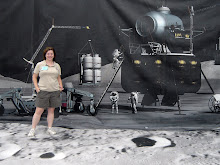
In just about six weeks, I'll be joining my second season with the Antarctic Search for Meteorites (ANSMET). I'm so excited! This year, I'll be on the reconnaissance team, scouting new icefields in the Transantarctic Mountains to see if any of them have a concentration of meteorites. It means I'll get to see a lot more scenery than the flat ice field where I spent last season! I'll be helping to maintain a web log of our activities, including sending some live data back from the field.
Why do we go to Antarctica to get meteorites? Meteorites fall randomly over the whole Earth throughout time. But, if a meteorite falls in the ocean, or fell 10,000 years ago, it's unlikely anyone's ever going to find it now. Once a meteorite lands, the Earth's forces of water and biology start breaking it down. There are some places on the Earth that are good for finding meteorites when there is a mechanism for concentrating many years' worth of falls in one spot and storing them under very dry conditions. The hot deserts are good for this, where meteorites land among the sand dunes and then when the wind shifts and starts blowing sand away, the meteorites are exhumed. Antarctica is also a good place because meteorites that fall on the glaciers get entrained in the ice (which is actually a pretty dry environment because the ice is so cold it never melts) and carried along the conveyor belt of the glacier. When the glacier runs up against a mountain, the winds convert the ice directly into the vapor phase (like leaving ice cubes too long in your freezer) and the meteorites are left behind. The ANSMET program has recovered more than 25,000 meteorites, or 85% of the world’s meteorite collection.
Why do we study meteorites? The basis of geology is that rocks hold information about the formation and evolution of their parent planet. On the Earth, we can hike around, study rocks in the field, and bring them to the lab for detailed analysis. But we've only collected rocks from only one other planetary field site, the Moon. So meteorites are especially scientifically valuable because they are the only rocks we have from Mars and the asteroids. Even lunar meteorites come from places on the Moon where human have never been and never sampled, and have given us a whole new view of lunar rocks. Remote-sensing techniques, like the spectrometers on our rover friends, are good at what they do but are still a far cry from being able to pick up a rock, crack it open, and measure its isotopic composition to, say, 1% accuracy.
Here's lots more about the scientific importance of meteorites, along with details on how they are collected and curated.
What's an ANSMET season like? You can check out last year's team blog or Linda's PSRD article written after the 2002 season. And, of course, you should tune in to my ANSMET blog to find out this year!
Wednesday, October 18, 2006


Tuesday, October 17, 2006
Rare meteorites and radar
Here’s another question from the blog comment box: "Riddle me this Science Girl....I just read this story on CNN. What is so new about ground penetrating radar. It has been around for a long time hasn't it? What kind of crystals are embedded in the iron and why are they important? What is with the white gloves? The thing has been in the ground on earth for 10,000 years, isn't that just a little dramatic?"
Pallasites are very rare meteorites. They are basically big crystals of olivine (in gemstone form, olivine is known as peridot) embedded in iron-nickel metal. Besides being incredibly beautiful, they’re scientifically interesting, but it takes a step back to explain why, so bear with me. Like the Earth, many planets heated up when they formed and the materials separated out roughly by density. We see that today on Earth as the crust, mantle, and core. Mars has a similar structure, and so does the asteroid Vesta, and probably so did many other asteroids that have since been blown into pieces by collisions. Pieces that fall to earth of these exploded tiny planets are recognizable as pieces of otherworldly crusts (achondrites) and cores (iron meteorites). We don’t have any meteorites that are definitely mantle material, but the Earth’s mantle is made largely of olivine, and remote sensing of Vesta and the Moon show olivine-rich material in deep craters, so by analogy, we think that asteroid mantles are made of olivine too. Where would olivine mix with metal? At the core-mantle boundary. So pallasites are samples from the core-mantle boundary of asteroids, a relatively narrow zone and so therefore relatively rare.
This specific meteorite, the Brenham pallasite, is one that has gotten amateurs excited for years. Smaller pieces of this meteorite have been found in farmers’ fields all throughout the midwest. Traditionally, meteorites are found by stumbling across them by accident or by systematically sweeping an area by eye or with metal detectors. In the case of Brenham, people suspected there could be more pieces lurking below the surface, and last year, meteorite hunters found the biggest piece of Brenham using a metal detector. The piece described in today's news story was found by combining two pursuits: looking for more pieces of Brenham and validating a hand-carried ground-penetrating radar instrument (that’s the “new” part of the radar) to find local buried resources, like meteorites and water (read more about that in the more explanatory AP story). OK, maybe white gloves are overkill considering all the other organic stuff that’s been crawling over the meteorite, but the recovery party (in part from the curation staff at the Johnson Space Center) was following standard protocol for recovering meteorites, which includes trying not to transfer any human skin oils to the meteorite. While it may have been on Earth a long time, it probably hasn’t been touched by humans ever.
Honestly, I did not plant this question, but it allows me a very graceful segueway into my next planetary adventure: the Antarctic Search for Meteorites. More on that in my next installment!
Pallasites are very rare meteorites. They are basically big crystals of olivine (in gemstone form, olivine is known as peridot) embedded in iron-nickel metal. Besides being incredibly beautiful, they’re scientifically interesting, but it takes a step back to explain why, so bear with me. Like the Earth, many planets heated up when they formed and the materials separated out roughly by density. We see that today on Earth as the crust, mantle, and core. Mars has a similar structure, and so does the asteroid Vesta, and probably so did many other asteroids that have since been blown into pieces by collisions. Pieces that fall to earth of these exploded tiny planets are recognizable as pieces of otherworldly crusts (achondrites) and cores (iron meteorites). We don’t have any meteorites that are definitely mantle material, but the Earth’s mantle is made largely of olivine, and remote sensing of Vesta and the Moon show olivine-rich material in deep craters, so by analogy, we think that asteroid mantles are made of olivine too. Where would olivine mix with metal? At the core-mantle boundary. So pallasites are samples from the core-mantle boundary of asteroids, a relatively narrow zone and so therefore relatively rare.
This specific meteorite, the Brenham pallasite, is one that has gotten amateurs excited for years. Smaller pieces of this meteorite have been found in farmers’ fields all throughout the midwest. Traditionally, meteorites are found by stumbling across them by accident or by systematically sweeping an area by eye or with metal detectors. In the case of Brenham, people suspected there could be more pieces lurking below the surface, and last year, meteorite hunters found the biggest piece of Brenham using a metal detector. The piece described in today's news story was found by combining two pursuits: looking for more pieces of Brenham and validating a hand-carried ground-penetrating radar instrument (that’s the “new” part of the radar) to find local buried resources, like meteorites and water (read more about that in the more explanatory AP story). OK, maybe white gloves are overkill considering all the other organic stuff that’s been crawling over the meteorite, but the recovery party (in part from the curation staff at the Johnson Space Center) was following standard protocol for recovering meteorites, which includes trying not to transfer any human skin oils to the meteorite. While it may have been on Earth a long time, it probably hasn’t been touched by humans ever.
Honestly, I did not plant this question, but it allows me a very graceful segueway into my next planetary adventure: the Antarctic Search for Meteorites. More on that in my next installment!
Friday, October 13, 2006
Conjunction junction and sol 1000!
Today's the last planning day for both rovers before solar conjunction. We're all excited because we're uploading 15 days of plans to each rover to conduct all on their own, then we'll get to drink from the firehose of data return in the last week of October!
The Mossbauer team is excited that we'll be using this chance to collect some fantastic Mossbauer integrations. The Mossbauer spectrometer works by exciting the sample with gamma rays and measuring the emmision and absorption response of the sample. The gamma ray energy on the rovers' Mossbauer spectrometer is tuned to iron, so that the response is a fingerprint of the iron-bearing minerals in the sample we're looking at. This is good because so much of Mars is iron-rich, so the Mossbauer mineralogy has been very useful. But, the Mossbauer source natually decays, and at more than 10 times its expected lifetime, the MB source is fairly weak. This means that to get a good signal-to-noise ratio, we need to leave the MB on a target for something like 48 hours to even get the major mineralogy. To tease out the fine details, it needs more time, and we're almost never able to give it that time before moving on - until now. Both rovers have more than 10 days of Mossbauer spectrometry planned over conjunction. Spirit is looking at her magnet, which has collected magnetic dust along its traverse, to look at what iron-bearing minerals make up the Martian dust from the atmosphere and the ground that gets kicked up by wind. Opportunity is looking at a patch of rock at Victoria crater and I'm super-excited to see what minerals it can find in the rock here!
While we're letting the rovers do their own thing during conjunction, their timers will roll over sol 1000! Since nobody expected them to live this long, much of their software was built to only accept 3-digit sols (up to 999). It's like Y2K for the rover - quick, buy some bottled water and duct tape! The ground and flight software engineers did a fabulous job of either fixing or working around this issue and testing it thoroughly, so we don't expect any problems. Still, I feel like when we next see our little friends, they'll have passed this major milestone.
The Mossbauer team is excited that we'll be using this chance to collect some fantastic Mossbauer integrations. The Mossbauer spectrometer works by exciting the sample with gamma rays and measuring the emmision and absorption response of the sample. The gamma ray energy on the rovers' Mossbauer spectrometer is tuned to iron, so that the response is a fingerprint of the iron-bearing minerals in the sample we're looking at. This is good because so much of Mars is iron-rich, so the Mossbauer mineralogy has been very useful. But, the Mossbauer source natually decays, and at more than 10 times its expected lifetime, the MB source is fairly weak. This means that to get a good signal-to-noise ratio, we need to leave the MB on a target for something like 48 hours to even get the major mineralogy. To tease out the fine details, it needs more time, and we're almost never able to give it that time before moving on - until now. Both rovers have more than 10 days of Mossbauer spectrometry planned over conjunction. Spirit is looking at her magnet, which has collected magnetic dust along its traverse, to look at what iron-bearing minerals make up the Martian dust from the atmosphere and the ground that gets kicked up by wind. Opportunity is looking at a patch of rock at Victoria crater and I'm super-excited to see what minerals it can find in the rock here!
While we're letting the rovers do their own thing during conjunction, their timers will roll over sol 1000! Since nobody expected them to live this long, much of their software was built to only accept 3-digit sols (up to 999). It's like Y2K for the rover - quick, buy some bottled water and duct tape! The ground and flight software engineers did a fabulous job of either fixing or working around this issue and testing it thoroughly, so we don't expect any problems. Still, I feel like when we next see our little friends, they'll have passed this major milestone.
Mission costs
OK, so there's been some contributed discussion to this blog recently about how wimpy the Mars exploration plans seem to be, and how getting a big rig over there to do it right is really what we need. I don't intend this blog to turn into a political forum, but seeing as it's *my* blog, here's my take on it:
Space exploration is difficult. Space exploration is risky. Space exploration is expensive. Every time a mission fails (because it is difficult), the public demands that the next mission not fail (become less risky) and therefore the price goes up (becomes more expensive). Remember that 90's NASA mantra, "Faster, better, cheaper?" The inside joke was that you could only choose two out of the three.
During the era of Apollo, Viking, and Voyager, space exploration was driven by political pressure, not by science. Each Viking lander cost $1 billion in the early 1970's. That's something like $5 billion in today's money. The Apollo program is estimated at about $100 billion in today's money. Even the Russian Luna rovers are estimated to have cost $1-2 billion each back then. Of course, we have developed more and better technology, bringing the cost of missions down, so using today's technology, a Viking mission might cost $1.5-2 billion. Current Mars Sample Return estimates run from $2 to 4 billion. The reality is that putting a huge drill rig on Mars is not able to happen in the curent climate, where space missions are seen as being driven by science, and society just doesn't think it needs that much science.
I'll accept criticism that NASA, like all big government agencies, spends a lot of its money on bureacracy and could really use more imagination. But even if you were able to somehow cut the costs in half, billion-dollar Mars missions driven by science, however supercool and fantastic science it is, are going to be nearly impossible to fund until society sees them as valuable to them. Let's make a cynical comparison here: the movie Titanic grossed 1.8 billion dollars. Yes, the world's people spent $1.8 BILLION to go see one darn movie. That's three Mars missions right there, for one single movie.
OK, end rant. No more politics. Back to science!!!
Space exploration is difficult. Space exploration is risky. Space exploration is expensive. Every time a mission fails (because it is difficult), the public demands that the next mission not fail (become less risky) and therefore the price goes up (becomes more expensive). Remember that 90's NASA mantra, "Faster, better, cheaper?" The inside joke was that you could only choose two out of the three.
During the era of Apollo, Viking, and Voyager, space exploration was driven by political pressure, not by science. Each Viking lander cost $1 billion in the early 1970's. That's something like $5 billion in today's money. The Apollo program is estimated at about $100 billion in today's money. Even the Russian Luna rovers are estimated to have cost $1-2 billion each back then. Of course, we have developed more and better technology, bringing the cost of missions down, so using today's technology, a Viking mission might cost $1.5-2 billion. Current Mars Sample Return estimates run from $2 to 4 billion. The reality is that putting a huge drill rig on Mars is not able to happen in the curent climate, where space missions are seen as being driven by science, and society just doesn't think it needs that much science.
I'll accept criticism that NASA, like all big government agencies, spends a lot of its money on bureacracy and could really use more imagination. But even if you were able to somehow cut the costs in half, billion-dollar Mars missions driven by science, however supercool and fantastic science it is, are going to be nearly impossible to fund until society sees them as valuable to them. Let's make a cynical comparison here: the movie Titanic grossed 1.8 billion dollars. Yes, the world's people spent $1.8 BILLION to go see one darn movie. That's three Mars missions right there, for one single movie.
OK, end rant. No more politics. Back to science!!!
Tuesday, October 10, 2006
What's the deal with water on Mars?
So here's a comment I got today: "I followed the reports early on that there was some impressive evidence that Mars was once covered with water. However I also seem to recall that a few months later there were some dissenting view points. So, riddle me this science girl...What is the deal? Was Mars a wet and wild world of acidic, sulfur laden dihygrogen monoxide? Are there suspected sites where drilling might reach liquid water? Or is Mars just a dusty bin of chilly rocks?" OK, so here's Science Girl's attempt to summarize many people's work on this topic!
I think the consensus now is that there is a lot of evidence of liquid water in Mars' past, but we're still a little fuzzy on the exact details - when, how much, how long it lasted, and where it was. Orbital photos have long showed things that look like branching river valleys and more recently, the MOC camera has captured many images of gullies in craters that might be caused by seeping subsurface water. There's definitely ice in the subsurface now, and presumably if you dug or drilled, you'd be able to get to it - the Phoenix mission will try to do just this - but it's likely to be mixed with rock or dust like the Arctic tundra, not like a subsurface glacier.
One of the biggest contributions to the story is Opportunity's view of the rocks at Meridiani Planum. There's pretty convincing evidence that these rocks are sediments that were laid down by flowing water on the surface. But, the environment that formed the rocks is probably more analogous to a braided stream or wash in the desert southwest than the oceanic shelf off the East Coast. We don't know exactly when these rocks were made, but we do know that at that time, there was a lot of sulfur and oxygen at the surface, making the Martian environment pretty harsh, acidic and oxidizing - very unpleasant for life as we unerstand it. We're just now trying to come to more understanding of the acidic/sulfuric environments vs more "clement" environments with CRISM, a mapping spectrometer on the MRO orbiter, which will be able to pick out areas with sulfates (acidic, sulfurous weathering) and areas with things like clays that we think formed under more neutral and less sulfurous conditions.
But having said all that, remember that Mars is an entire planet. Think about it - is the Earth covered with water? Well, yes and no, sometimes it was in some places and sometimes in others, sometimes the water is liquid and sometimes it is ice. The rocks exposed in the Grand Canyon were laid down by a vast ocean 500 million years ago, but southern Utah is now a windy, barren desert. Underneath the Pacific Ocean, the rocks are formed by erupting magma and have only trace amounts of water in them. The Earth is geologically complex and has 4.5 billion years of history complicating it, but we've been living here and studying the world around us for tens of thousands of years. Mars is also geologically complex and also has 4.5 billion years of history, but we've been studying it only remotely and for only three decades. It's a long process, figuring out Mars, and science is about getting more and more little pieces that we integrate into our understanding, rather than sending one spacecraft and expecting it to tell us the conclusive story. But, of course, each of our little pieces comes with a price tag and so we need to make sure we wring all the science we can out of it and tell everyone what pieces we are finding!
I think the consensus now is that there is a lot of evidence of liquid water in Mars' past, but we're still a little fuzzy on the exact details - when, how much, how long it lasted, and where it was. Orbital photos have long showed things that look like branching river valleys and more recently, the MOC camera has captured many images of gullies in craters that might be caused by seeping subsurface water. There's definitely ice in the subsurface now, and presumably if you dug or drilled, you'd be able to get to it - the Phoenix mission will try to do just this - but it's likely to be mixed with rock or dust like the Arctic tundra, not like a subsurface glacier.
One of the biggest contributions to the story is Opportunity's view of the rocks at Meridiani Planum. There's pretty convincing evidence that these rocks are sediments that were laid down by flowing water on the surface. But, the environment that formed the rocks is probably more analogous to a braided stream or wash in the desert southwest than the oceanic shelf off the East Coast. We don't know exactly when these rocks were made, but we do know that at that time, there was a lot of sulfur and oxygen at the surface, making the Martian environment pretty harsh, acidic and oxidizing - very unpleasant for life as we unerstand it. We're just now trying to come to more understanding of the acidic/sulfuric environments vs more "clement" environments with CRISM, a mapping spectrometer on the MRO orbiter, which will be able to pick out areas with sulfates (acidic, sulfurous weathering) and areas with things like clays that we think formed under more neutral and less sulfurous conditions.
But having said all that, remember that Mars is an entire planet. Think about it - is the Earth covered with water? Well, yes and no, sometimes it was in some places and sometimes in others, sometimes the water is liquid and sometimes it is ice. The rocks exposed in the Grand Canyon were laid down by a vast ocean 500 million years ago, but southern Utah is now a windy, barren desert. Underneath the Pacific Ocean, the rocks are formed by erupting magma and have only trace amounts of water in them. The Earth is geologically complex and has 4.5 billion years of history complicating it, but we've been living here and studying the world around us for tens of thousands of years. Mars is also geologically complex and also has 4.5 billion years of history, but we've been studying it only remotely and for only three decades. It's a long process, figuring out Mars, and science is about getting more and more little pieces that we integrate into our understanding, rather than sending one spacecraft and expecting it to tell us the conclusive story. But, of course, each of our little pieces comes with a price tag and so we need to make sure we wring all the science we can out of it and tell everyone what pieces we are finding!
Friday, October 06, 2006
Mars: The hip new place to see and be seen
I nearly fell off my chair when my friend on the HiRISE team told me he'd seen us at Victoria Crater. You have to go check out the amazing, new, color images of Victoria as taken by the MRO camera at the HiRISE web page. I snipped out a zoom of the image here, where you can see the little trapezoid that is the rover deck and solar panels, the shadow of the camera mast falling to the right of the rover, and - oh my gosh - Opportunity's *tracks* to her position now on the Cape Verde promontory. Below that, you can also see her tracks out of the lower valley, called Duck Bay. How cool is this?!?!
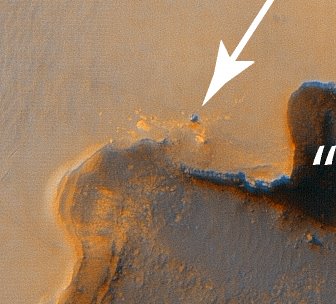
Here's a link to the MRO Press Release that tells you more about the image.
So this is approximately where Opportunity is now, and will be for the next couple of weeks. Right now, Mars is opposite the Earth in their orbits - For every year that it takes Earth to go around the sun, it takes Mars about two. So sometimes, like last spring and in 2004, Mars and Earth are near the same points in their orbits and close together on the same side of the sun. That's when you can see Mars brightly shining in the night sky (and when you get those email hoaxes that Mars looks the same size as the Moon). In the off years, Mars is on the other side of its orbit from us, and the sun is in between our line of sight, called "solar conjunction" because Mars and the Sun appear to be close in the sky. When this happens, we can't communicate with spacecraft there and everyone takes a two-week break. Last time, the rovers took two weeks off too, but this year, we're radiating 15-day plans to them to continue to do science on their own!
Here's a link to the MRO Press Release that tells you more about the image.
So this is approximately where Opportunity is now, and will be for the next couple of weeks. Right now, Mars is opposite the Earth in their orbits - For every year that it takes Earth to go around the sun, it takes Mars about two. So sometimes, like last spring and in 2004, Mars and Earth are near the same points in their orbits and close together on the same side of the sun. That's when you can see Mars brightly shining in the night sky (and when you get those email hoaxes that Mars looks the same size as the Moon). In the off years, Mars is on the other side of its orbit from us, and the sun is in between our line of sight, called "solar conjunction" because Mars and the Sun appear to be close in the sky. When this happens, we can't communicate with spacecraft there and everyone takes a two-week break. Last time, the rovers took two weeks off too, but this year, we're radiating 15-day plans to them to continue to do science on their own!
Wednesday, September 27, 2006
Martian craters

I know you've all been waiting for it as eagerly as we have .... today we're planning our last, cautious bump to the rim of Victoria Crater! Check out the images of Opportunity's approach via her navigation cameras: Tuesday and Wednesday. Today we'll be planning out the campaign that we'll conduct at Victoria. Basically, Opportunity will start with some spectacular remote sensing, so look for that later this week. Then, the team will decide which direction to start circumnavigating Victoria. We're expecting some fantastic orbital imaging from the HiRISE camera onboard the Mars Reconnaissance Orbiter that will help guide the team's decisions on where to stop and hopefully, where to think about entering this beautiful crater! Stay tuned....
Terrestrial craters
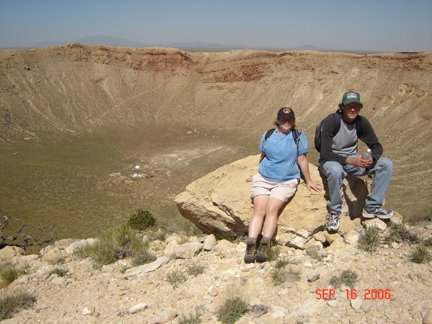
Last weekend I took a group of students and other scientists from UNM to Meteor Crater, just down the road from us in Winslow, AZ. We circumnavigated the crater (~2.5 km) in the morning and spent the aafternoon looking at ejecta nearby. It was good to see again just what a crater form looks like in person. When you see pictures, craters tend to look like bowls with gently sloping sides, and it's easy to think of the rovers as skating down them like halfpipes. But when you really see them in person, impact craters are imposing features, lined with near-vertical cliffs and jagged outcrops.
It was a real treat to have a fellow MER scientist, proto-Dr. Shawn Wright from ASU (below, with me at the crater edge), join us there to show us some of the remote sensing he did of the crater. Shawn came fresh off field work looking at potential craters in South America and though tired, he was enthusiastic about guiding us to his favortite locations around the crater. At several stops, we could easily trace cliff outcrops and correlate specific ejecta lobes with remote sensing imagery because of Meteor Crater's unique (and fortuitous) target material: discrete layers of red siltstone, yellow limestone, and sugary white sandtone.

It was a real treat to have a fellow MER scientist, proto-Dr. Shawn Wright from ASU (below, with me at the crater edge), join us there to show us some of the remote sensing he did of the crater. Shawn came fresh off field work looking at potential craters in South America and though tired, he was enthusiastic about guiding us to his favortite locations around the crater. At several stops, we could easily trace cliff outcrops and correlate specific ejecta lobes with remote sensing imagery because of Meteor Crater's unique (and fortuitous) target material: discrete layers of red siltstone, yellow limestone, and sugary white sandtone.
Wednesday, September 13, 2006
It's dark when I wake up
I know we're sliding into autumn for real when the sun's no longer up when my alarm clock goes off at 5:30 am (!). My daily attitude is definitely controlled by the sun - on sunny days I'm bouncy and energetic, and rainy days make me want to curl up on the sofa with a good novel and a warm cat. As the amount of sunlight in my day shrinks, I feel like I lose energy - just like our little friends on Mars. So we're all very relieved and happy that Spirit made it through the depths of another Martian winter with even enough energy to continue doing at least a little bit of science nearly every day. Power levels are on the rise again, little by little, and the rover appears to be in good health. Of course, the rover doesn't have to wake up until local sunrise *yawn* .
Opportunity, being near the equator, has my perfect life - sunny and warm year-round. She continues to zip along toward Victoria Crater, whose ejecta blanket turned out to look a lot like the normal Meridiani plains - flat, hard, some sand drifts. On sol 929 Opportunity almost got a hole-in-one by driving 100.31 meters to the small crater Emma Dean, where we are trying to look at what the bedrock in the ejecta blanket is. We got our last good look at the "normal" Meridiani rock at Beagle Crater (yes, another shameless plug for a caption I wrote). It's a really spectacular mosaic - and - there's a super-cool quicktime window you can open and scroll around the panorama from the center. Sweet!
Opportunity, being near the equator, has my perfect life - sunny and warm year-round. She continues to zip along toward Victoria Crater, whose ejecta blanket turned out to look a lot like the normal Meridiani plains - flat, hard, some sand drifts. On sol 929 Opportunity almost got a hole-in-one by driving 100.31 meters to the small crater Emma Dean, where we are trying to look at what the bedrock in the ejecta blanket is. We got our last good look at the "normal" Meridiani rock at Beagle Crater (yes, another shameless plug for a caption I wrote). It's a really spectacular mosaic - and - there's a super-cool quicktime window you can open and scroll around the panorama from the center. Sweet!
August travel update II
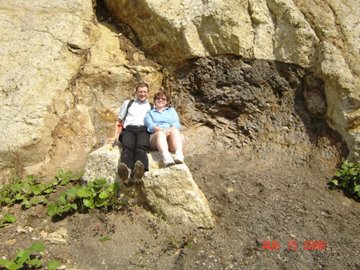
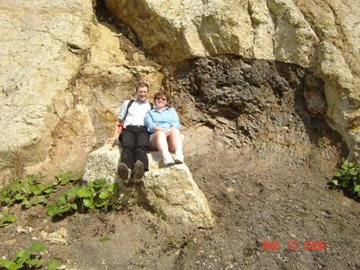
I mentioned a while back on this blog that one of the highlights of my summer was going to be visiting the Ries Crater in southern Germany - and it was. Here's a photo of me with Walter Goetz, who's one of the investigators on the MER Magnetic Properties Experiment. Walter joined me, Rob, and Gisela Poesges from the Ries Crater Museum for 2 days of fun on the outcrops inside and outside the Ries. We were also joined on the second day by Iris Fleischer and a group of grad students from the Mossbauer group in Mainz. It was super fantastic, really amazing to see the different kinds of ejecta so well preserved, we had tolerable weather except for one downpour, and Gisela knew all the best places to see shatter cones, the crater rim, megablocks, and lunch stops! Walter and I both got a lot out of the trip, trying to see impact products from the rover's point of view, and bringing back lots of samples for further study. Rob maybe didn't get so much out of the rocks, but Gisela did give him a chocolate model of the Ries Crater.
After Ries, Rob & I spent a couple of days in Krakow and western Poland checking out my family roots, then drove to Prague for the IAU meeting. It was a timely meeting to attend because it was where all the planet-definition discussion was heating up, culminating in the vote that redefined Pluto. I couldn't vote, because I'm not a member of the IAU, so don't send me hate email. Honestly, I didn't think it would fly, because at a contentious lunchtime forum during the week, the panel asked for an informal show of hands and the proposals were soundly rejected. Basically, everyone is upset at different aspects of the proposal so there was no consensus. It's far from over and don't be surprised when the IAU takes this up again in 3 years at their next meeting.
(You're wondering how I would have voted? We now understand that Pluto is the prototype of this belt of icy objects in the outer solar system - it's a new discovery and reflects our new understanding of the solar system, and *that's* exciting. How to codify it scientifically seems less of a problem than dealing with the "public outrage." I did a radio interview last week on the topic and one of the other guests says he knows someone who learned the planets *before* there was Pluto. I wonder what that was like, did people protest that now all the textbooks were obsolete and how could they be expected to come up with a new mnemonic? Crazy.)
After Ries, Rob & I spent a couple of days in Krakow and western Poland checking out my family roots, then drove to Prague for the IAU meeting. It was a timely meeting to attend because it was where all the planet-definition discussion was heating up, culminating in the vote that redefined Pluto. I couldn't vote, because I'm not a member of the IAU, so don't send me hate email. Honestly, I didn't think it would fly, because at a contentious lunchtime forum during the week, the panel asked for an informal show of hands and the proposals were soundly rejected. Basically, everyone is upset at different aspects of the proposal so there was no consensus. It's far from over and don't be surprised when the IAU takes this up again in 3 years at their next meeting.
(You're wondering how I would have voted? We now understand that Pluto is the prototype of this belt of icy objects in the outer solar system - it's a new discovery and reflects our new understanding of the solar system, and *that's* exciting. How to codify it scientifically seems less of a problem than dealing with the "public outrage." I did a radio interview last week on the topic and one of the other guests says he knows someone who learned the planets *before* there was Pluto. I wonder what that was like, did people protest that now all the textbooks were obsolete and how could they be expected to come up with a new mnemonic? Crazy.)
August travel update I
I had a great time traveling in August but I am so happy to be back in the saddle. I had real withdrawal symptoms while I was off doing other things and not always able to keep up with what's going on on Mars. I carried my laptop around, hungrily looking for wireless connections and internet cafes :)
In Zurich, at the Meteoritical Society meeting, I had a great time talking with some of our European APXS/MB colleagues including Christian Schroeder and Jutta Zipfel. We're all very excited that both rovers just uplinked a flight software update -an amazing thing to do so late in the mission - that includes some fantastic new capabilities for our little buddies. The most exciting thing for us IDD types is the ability to go-and-touch. Up til now, we need a full sol to approach a rock and downlink images from the hazard-avoidance cameras, then there's a human in the loop to assess the images and determine how safe it is to deploy and extend the arm out to touch a rock that we want to look at, then then next sol we uplink the touch command and can start taking data. Because of the vagaries of the planning process, this can actually take more than one sol sometimes. The new software will (hopefully) allow the rover to make an independent determination of a safe place to put the arm instruments and go and do it without us, saving us a sol (or more) of real time.
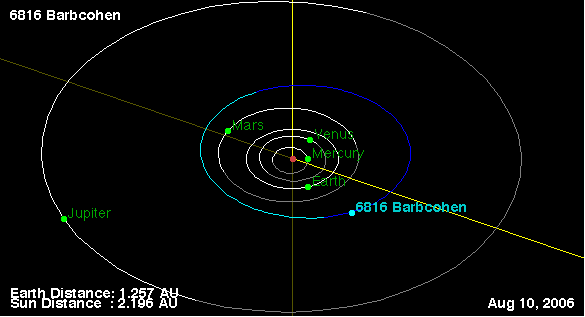
Also in Zurich, I found out to my surprise and infinite delight that the asteroid formerly known as 1981 EB28 is now officially 6816 Barbcohen! How cool is that! Read the UNM story about it here. It's only a tiny speck of a rock in the main belt, but this is where it was on Aug. 10, the day I found out!
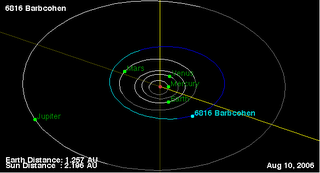
You can see where it is any time by going here. Of course, Spirit and Opportunity already have theirs too!
In Zurich, at the Meteoritical Society meeting, I had a great time talking with some of our European APXS/MB colleagues including Christian Schroeder and Jutta Zipfel. We're all very excited that both rovers just uplinked a flight software update -an amazing thing to do so late in the mission - that includes some fantastic new capabilities for our little buddies. The most exciting thing for us IDD types is the ability to go-and-touch. Up til now, we need a full sol to approach a rock and downlink images from the hazard-avoidance cameras, then there's a human in the loop to assess the images and determine how safe it is to deploy and extend the arm out to touch a rock that we want to look at, then then next sol we uplink the touch command and can start taking data. Because of the vagaries of the planning process, this can actually take more than one sol sometimes. The new software will (hopefully) allow the rover to make an independent determination of a safe place to put the arm instruments and go and do it without us, saving us a sol (or more) of real time.
Also in Zurich, I found out to my surprise and infinite delight that the asteroid formerly known as 1981 EB28 is now officially 6816 Barbcohen! How cool is that! Read the UNM story about it here. It's only a tiny speck of a rock in the main belt, but this is where it was on Aug. 10, the day I found out!
You can see where it is any time by going here. Of course, Spirit and Opportunity already have theirs too!
Thursday, July 27, 2006
A month of science
Sorry for being lax this month. I am on my way back from my second Athena Science Team meeting. These meetings are giant science festivals, where people present ideas, works in progress, and results from recent experiments and observations. Even if you've been keeping up with the rovers' daily observations, its still difficult to get the bigger picture sometimes, so these meetings are very very useful. There were a couple of sets of presentations about questions that gnaw at us all - what is Home Plate? What is the structure of the Columbia Hills? How do rocks weather on Mars? How old is Victoria Crater? I gave a presentation about Gusev crater, its formation & structure, and how its central peak might underlie the expression of the Columbia Hills (really speculative). When we get the whole team together, it generates some fantastic discussion and really gets me jazzed for working on this amazing dataset!
This summer, I've been focusing on trying to understand Martian impact glass. A couple of the rock types in the Columbia Hills appear to have a glass component in some of the infrared spectra. But, when glassy rocks form on the Earth, they are very easily altered and weathered away. So, it's a little bit of a paradox as to why ancient Martian rock that look weathered still have glass in them. Plus, we don't really understand what the glass is or how much is there. Fortunately for us, we have a couple of examples of Martian glass here on Earth contained in the Martian meteorites. It may not be exactly the same glass, or even formed the same way, but I can do a lot more with a sample in my lab than the rovers can do on the surface. So, I'm trying to characterize the meteorite glass using various lab methods and compare it with our rock data from the mission. I'll be presenting my progress so far at two meetings in August: the Meteoritical Society meeting in Zurich and the International Astronomical Union in Prague. Yes, it's a rough life I lead this summer :)
This summer, I've been focusing on trying to understand Martian impact glass. A couple of the rock types in the Columbia Hills appear to have a glass component in some of the infrared spectra. But, when glassy rocks form on the Earth, they are very easily altered and weathered away. So, it's a little bit of a paradox as to why ancient Martian rock that look weathered still have glass in them. Plus, we don't really understand what the glass is or how much is there. Fortunately for us, we have a couple of examples of Martian glass here on Earth contained in the Martian meteorites. It may not be exactly the same glass, or even formed the same way, but I can do a lot more with a sample in my lab than the rovers can do on the surface. So, I'm trying to characterize the meteorite glass using various lab methods and compare it with our rock data from the mission. I'll be presenting my progress so far at two meetings in August: the Meteoritical Society meeting in Zurich and the International Astronomical Union in Prague. Yes, it's a rough life I lead this summer :)
Thursday, June 29, 2006
New press release
Last week, I attended a meeting of lunar scientists to talk about the science direction of the return to the Moon "vision" that NASA has. After work, we got talking about Mars, and one of my colleagues said that he was disappointed at the lack of depth in the MER outreach web pages. He said, it's always that the rover is looking at a rock, and he thinks, well duh, of course the rover is looking at a rock, that what the rovers do. But why? What's the science?
It was with that comment fresh in my mind that I was asked to write a caption for this week's public image release for Spirit, which has been working on this really interesting rock. We had to do a little bit of work to strike the right balance between getting the interesting part to the public while still being cautious because the results come out so fast that we scientists don't always have time to keep up with the data before moving on, and so our detailed science can lag behind the rovers' discoveries. The chemical and mineralogical data, in particular, take a lot of time and attention to be sure the calibrations and interpretations are the best we can do. In the case of Halley this week, I was pleased that we were able to give some specifics that the team agrees on.
It was with that comment fresh in my mind that I was asked to write a caption for this week's public image release for Spirit, which has been working on this really interesting rock. We had to do a little bit of work to strike the right balance between getting the interesting part to the public while still being cautious because the results come out so fast that we scientists don't always have time to keep up with the data before moving on, and so our detailed science can lag behind the rovers' discoveries. The chemical and mineralogical data, in particular, take a lot of time and attention to be sure the calibrations and interpretations are the best we can do. In the case of Halley this week, I was pleased that we were able to give some specifics that the team agrees on.
Friday, June 23, 2006
Sunday, June 18, 2006
Rovers don't take vacations
As you can probably tell from the sporadic nature of this blog, I had a pretty busy travel schedule over the spring, not all of it related to Mars. I had long ago blocked out last week for "vacation" - not planning to go anywhere, just to take some mental time off. Well, instead I spent three of the days working for the rovers, two by schedule and one by volunteer. It's completely addictive. Opportunity has extricated herself from the Jammerbugt dune and we drove and took pictures of tracks last week. Spirit is still sitting in place taking the 360 degree Pancam mosaic.
But speaking of Pancam, last week I found myself in upstate NY for some family things and took a slight detour up to Ithaca for a couple of hours. I spent part of Opportunity's planning day with the Pancam crew at Cornell, which was fantastic (in that inner geeky way). I met several of the payload uplink people, with whom I've interacted on the telecon line many times, and got to see where the polycon shows them hard at work. I also was able to ask lots of questions about compression algorithms and other super geeky things I wonder about during the planning process. I don't think I'll be an expert remote senser anytime soon but the more I am able to actively interact, the more things soak in eventually.
Finally, my idol Steve Squyres was on the Colbert Report on Comedy Central last week; you can see the video clip there or download the entire 06/07/07 episode from iTunes. The more Steve does on this mission the more in awe of him I am and the more nervous I get around him! But Stephen Colbert does a great interview - he had a similar idea as mine - to drive the two rovers toward each other. OK, my idea was to have Robot Wars (verrrrrry sloooooowly) and his was to mate them and create a race of robot overlords, whatever. Each rover only has to travel 5336 km to meet in the middle; Spirit has driven 6.9 km already and Opportunity 8.1 km. At an average speed of 3.8 km/year, it'll only take another 1400 years or so. Stay tuned!
But speaking of Pancam, last week I found myself in upstate NY for some family things and took a slight detour up to Ithaca for a couple of hours. I spent part of Opportunity's planning day with the Pancam crew at Cornell, which was fantastic (in that inner geeky way). I met several of the payload uplink people, with whom I've interacted on the telecon line many times, and got to see where the polycon shows them hard at work. I also was able to ask lots of questions about compression algorithms and other super geeky things I wonder about during the planning process. I don't think I'll be an expert remote senser anytime soon but the more I am able to actively interact, the more things soak in eventually.
Finally, my idol Steve Squyres was on the Colbert Report on Comedy Central last week; you can see the video clip there or download the entire 06/07/07 episode from iTunes. The more Steve does on this mission the more in awe of him I am and the more nervous I get around him! But Stephen Colbert does a great interview - he had a similar idea as mine - to drive the two rovers toward each other. OK, my idea was to have Robot Wars (verrrrrry sloooooowly) and his was to mate them and create a race of robot overlords, whatever. Each rover only has to travel 5336 km to meet in the middle; Spirit has driven 6.9 km already and Opportunity 8.1 km. At an average speed of 3.8 km/year, it'll only take another 1400 years or so. Stay tuned!
Friday, June 02, 2006
Thinking ahead
Like 3 years ahead. This week I participated in the 1st workshop on where to land the Mars Science Laboratory in 2009. The Mars Science Laboratory is a huge rover - it looks like a really big version of MER but it's got 3x as many instruments, an expected lifetime of 2 years, and a roving capability of more than 20 km. But, there's only one of them, not twins like the MERs, and everybody wants MSL to land in a different spot on Mars. We've only landed in 5 places so far, so the planet is wide open! I talked about my preference for going to ancient terrain where we can try to assess what the early crust of Mars was and how it was changed by water at a time in Martian history when we think conditions were less harsh than they are now. To my sincere surprise, the site I (and two other people) advocated generated a lot of interest and will be getting a lot of extra remote sensing time in the upcoming months to characterize it more and see if it really is as fantastic a landing site as we think it is. Even without that bonus, it was a really interesting workshop, where scientists from all different disciplines and backgrounds came together just to talk about what makes a good landing site and what we as a community are interested in seeing and what tools we have or can get to make sure we pick the best spot possible for this highly capable mission. I felt quite priviledged to be a part of it, and I have my involvement in MER to thank for giving me the entry point into the community of Mars science.
Friday, May 26, 2006
Victoria Crater
While Spirit is stuck in one place for a while, looking at the sky and dirt, I've been paying a lot more attention to Opportunity. Over at Meridiani Planum, we're headed toward this huge (by rover standards) hole in the ground, Victoria crater. Craters over here are named after great ships of exploration, and Victoria was the only ship to successfully return from Magellan's voyage around the world. Victoria crater is just about the size of Meteor Crater here in the southwest, a little less than 1 km wide. Check out the rim of Victoria crater as Opportunity approaches.
Victoria punched a deeper hole into the Meridiani Planum surface than the last big crater Opportunity visited, Endurance crater. Endurance crater was where we got to check out Burns Cliff, a fantastically well-preserved set of sedimentary layers in the inside crater wall that showed crossbedding, evaporite mineral casts, and the little hematite blueberries. Craters are nature's roadcuts, the way these little mechanical geologists will be able to check out what's underneath the surface of the plains, and we're all hoping that the inside walls of Victoria show us more wonders.
Right now, Opportunity is about to roll up onto Victoria's ejecta blanket, which is the apron of material that was thrown out of the crater and rained down around it. When craters form, a lot of stuff gets thrown out from a depth roughly as much as the drater diameter. As the rocks deform and fail with the crater shock, the final crater is much shallower, only about a tenth as deep as the diameter. So, the rocks in the ejecta blanket come from much deeper down than the rocks at the bottom of the crater now. If you want to look for the deepest rocks, you look at the edges of the ejecta, which is what's next on our journey. We're stopping nearly every weekend to check out our surroundings to see if anything is different yet.
It's a little ironic - we're now interested in changes in the rocks but all we see are really large expanses of the same Meridiani Planum bedrock. One of the science team members remarked that last year, huge expanses of crossbedded bedrock would have been nirvana for this rover. But the scientists were so good at eking out the geologic history from what small outcrops they had that now we are just enjoying this area for the ease of driving over lots of flat material.
Victoria punched a deeper hole into the Meridiani Planum surface than the last big crater Opportunity visited, Endurance crater. Endurance crater was where we got to check out Burns Cliff, a fantastically well-preserved set of sedimentary layers in the inside crater wall that showed crossbedding, evaporite mineral casts, and the little hematite blueberries. Craters are nature's roadcuts, the way these little mechanical geologists will be able to check out what's underneath the surface of the plains, and we're all hoping that the inside walls of Victoria show us more wonders.
Right now, Opportunity is about to roll up onto Victoria's ejecta blanket, which is the apron of material that was thrown out of the crater and rained down around it. When craters form, a lot of stuff gets thrown out from a depth roughly as much as the drater diameter. As the rocks deform and fail with the crater shock, the final crater is much shallower, only about a tenth as deep as the diameter. So, the rocks in the ejecta blanket come from much deeper down than the rocks at the bottom of the crater now. If you want to look for the deepest rocks, you look at the edges of the ejecta, which is what's next on our journey. We're stopping nearly every weekend to check out our surroundings to see if anything is different yet.
It's a little ironic - we're now interested in changes in the rocks but all we see are really large expanses of the same Meridiani Planum bedrock. One of the science team members remarked that last year, huge expanses of crossbedded bedrock would have been nirvana for this rover. But the scientists were so good at eking out the geologic history from what small outcrops they had that now we are just enjoying this area for the ease of driving over lots of flat material.
Tuesday, May 02, 2006
Martian winter work, terrestrial summer work
Spirit is nestled snugly in her Winter Haven and we are all getting in on the chance to conduct experiments that we never seem to have time for when we are on the move. Spirit is parked on the slope of Low Ridge, an arcuate feature that might be connected to, and possibly related to, Home Plate. Directly in front of the rover is an expanse of drifted dust and/or soil, which is the first target of an intense campaign with all the arm instruments to make measurements progressively deeper into the soil. There's also a long list of rock and soil targets for miniTES, some long-timeline atmospheric observations, and a monster panorama of our surroundings in all 13 Pancam filters, which should be really beautiful. For those of us interested in rocks, we have poor choices right now. There are a couple of clasts and possibly a shingle in our workvolume, which we will investigate. Several of us are hoping that after the solstice, we will be able to move to some rock targets ahead of us to figure out the geology of Low Ridge, its relationship to Home Plate, and the origin of some of these volcanic units around us.
In terrestrial analog news, I will be heading to the Ries Crater in Nordlingen, Germany, after the Meteoritical Society meeting this summer. Ries is a well-preserved 24-km diameter, 15 Ma crater with post-impact lacustrine layers inside and fantastic outcrops of ejecta. The Ries ejecta may be a good analog to Martian double-layered ejecta deposits. There is an upper ejecta layer (suevite) which is a mix of deep material and impact melt, overlying a lower layer (the Bunte breccia) which is an interesting unit formed when the first (shallow) ejecta was ballistically emplaced and churned up the substrate, mobilizing it and causing a radial flow. It is rumored there are distal parts of the Bunte breccia containing crossbeds and lapilli that may be potentially interesting to compare with proposed origins of Meridiani and/or layers in the Inner Basin. Cool!
In terrestrial analog news, I will be heading to the Ries Crater in Nordlingen, Germany, after the Meteoritical Society meeting this summer. Ries is a well-preserved 24-km diameter, 15 Ma crater with post-impact lacustrine layers inside and fantastic outcrops of ejecta. The Ries ejecta may be a good analog to Martian double-layered ejecta deposits. There is an upper ejecta layer (suevite) which is a mix of deep material and impact melt, overlying a lower layer (the Bunte breccia) which is an interesting unit formed when the first (shallow) ejecta was ballistically emplaced and churned up the substrate, mobilizing it and causing a radial flow. It is rumored there are distal parts of the Bunte breccia containing crossbeds and lapilli that may be potentially interesting to compare with proposed origins of Meridiani and/or layers in the Inner Basin. Cool!
Monday, April 24, 2006
Roving Mars!
Rob and I finally went to see Roving Mars this weekend in Phoenix. It's an IMAX film about the launch and landing of Spirit and Opportunity and has some really spectacular full-screen renderings of some of the early data. It wasn't as long as I would have liked but it was amazing to see some of the pictures on the humongous screen. Also, I was glad to see some of the cenes of the scientists when landing occurred - I was in a tent in Antarctica at the time and missed the excitement. Something about Steve Squyres having his own IMDb entry strikes me as hilarious, though his brother Tim is a bona fide Hollywood editor.
Spirit is definitely nestling down for a long winter in her present location. Unfortunately for me, there's no good rocks right in front of the rover, so my grand plans for multi-rock analysis campaigns will have to wait until after the southern Martan winter solstice (August 8). The soil and remote sensing people are kicking into high gear for the first part of winter and have some really cool plans for looking at different levels in the soil and acquiring the McMurdo Pan, a grand 13-filter panorama of everything around us. Opportunity is still zipping along, less than 1500 m to go to Victoria crater!
So, while I am supporting operations, I'm trying to dig into some data analysis, including multivariate analysis. I took linear algebra in college as an elective because I am such a geek. It was one of the few classes where I succumbed to the whining refrain, "When will I ever use this in the real world?" Well, 15 years later, it's come round to haunt me with whispers of eigenvectors.....
Spirit is definitely nestling down for a long winter in her present location. Unfortunately for me, there's no good rocks right in front of the rover, so my grand plans for multi-rock analysis campaigns will have to wait until after the southern Martan winter solstice (August 8). The soil and remote sensing people are kicking into high gear for the first part of winter and have some really cool plans for looking at different levels in the soil and acquiring the McMurdo Pan, a grand 13-filter panorama of everything around us. Opportunity is still zipping along, less than 1500 m to go to Victoria crater!
So, while I am supporting operations, I'm trying to dig into some data analysis, including multivariate analysis. I took linear algebra in college as an elective because I am such a geek. It was one of the few classes where I succumbed to the whining refrain, "When will I ever use this in the real world?" Well, 15 years later, it's come round to haunt me with whispers of eigenvectors.....
Friday, April 07, 2006
Sand trap
Wow, I'm sorry I haven't updated you all in a month! I've been traveling a lot this semester for work unrelated to MER.
Here on Earth, we had a fantastic turnout for the MER sessions at the Lunar and Planetary Science Conference, where the team updated everyone on the current science and other members of the community got to offer their own interpretations. Always lively, sometimes contentious, never boring. It's an exciting time to be looking at this data! I presented my poster on my ejecta calculations - how much ejecta from far-away terrains should we expect to find at the MER landing sites? I'll give you a clue: not much. But you can see the whole paper here. It's my first single-author paper and it was published on my birthday this year!
Up on Mars, Spirit is dragging a wheel. It's the right front wheel, the one that went gimpy early in the mission. At this point, it is steerable but not driveable and so it's just dragging behind us. In principle, that's fine and the rover is totally ok driving with 5 wheels. In practice, we got terribly bogged down in some soft, sandy soils and had some real scary days where the rover wheels dug in and we watched our power sink lower and lower. We re-evaluated our plans to get to north-facing slopes and decided to retreat back the way we came to better ground.
We chose a Winter Haven along Low Ridge, a small feature possibly connected to Home Plate, with nice slopes and lots of rocks. We're now developing plans for what to do there as Spirit waits out the winter. I think it's going to be a really exciting time because we will finally have time to sit in one place and do some detailed analyses of rocks and soils, so I'm actually very much looking forward to the winter, despite the scary power numbers!
On the other side of the planet, things are looking zippy - literally. Being nearer the equator and dust-free, Opportunity continues to have a favorable power situation even into the wintertime and is making amazing mileage along dune troughs and outcrop rock. We're only 2 crater radii away now from this humongous crater, Victoria, which is Opportunity's destination. It's old and eroded but probably dug pretty deeply into Meridiani Planum, so it should be super interesting when we arrive.
Here on Earth, we had a fantastic turnout for the MER sessions at the Lunar and Planetary Science Conference, where the team updated everyone on the current science and other members of the community got to offer their own interpretations. Always lively, sometimes contentious, never boring. It's an exciting time to be looking at this data! I presented my poster on my ejecta calculations - how much ejecta from far-away terrains should we expect to find at the MER landing sites? I'll give you a clue: not much. But you can see the whole paper here. It's my first single-author paper and it was published on my birthday this year!
Up on Mars, Spirit is dragging a wheel. It's the right front wheel, the one that went gimpy early in the mission. At this point, it is steerable but not driveable and so it's just dragging behind us. In principle, that's fine and the rover is totally ok driving with 5 wheels. In practice, we got terribly bogged down in some soft, sandy soils and had some real scary days where the rover wheels dug in and we watched our power sink lower and lower. We re-evaluated our plans to get to north-facing slopes and decided to retreat back the way we came to better ground.
We chose a Winter Haven along Low Ridge, a small feature possibly connected to Home Plate, with nice slopes and lots of rocks. We're now developing plans for what to do there as Spirit waits out the winter. I think it's going to be a really exciting time because we will finally have time to sit in one place and do some detailed analyses of rocks and soils, so I'm actually very much looking forward to the winter, despite the scary power numbers!
On the other side of the planet, things are looking zippy - literally. Being nearer the equator and dust-free, Opportunity continues to have a favorable power situation even into the wintertime and is making amazing mileage along dune troughs and outcrop rock. We're only 2 crater radii away now from this humongous crater, Victoria, which is Opportunity's destination. It's old and eroded but probably dug pretty deeply into Meridiani Planum, so it should be super interesting when we arrive.
Subscribe to:
Posts (Atom)