Catching up on funnies:
Working on the space station: Day 1: Comic where the artist takes reader suggestions for the character's actions. Quite funny, especially if you've ever played an adventure game.
Giant Spider attacks Space Shuttle: "One thing is for certain: there is no stopping them; the ants will soon be here. And I for one welcome our new insect overlords." - Kent Brockman
LRO Lego Model: The Lego model has successfully completed all qualification testing and passed its final acceptance review. The project management is also using this as a test of the LRO team members' ability to problem solve in preparation for I&T. Ron Kolecki will be on call for the mandatory inspection points. Dave Everett will verify the technical integrity. Craig Tooley will make sure you stay on schedule. Good luck, and may the frictional force be with you.
Happy Holidays from Mike Griffin: The Twelve Days of Christmas and the Vision for Space Exploration.
Mars Rover Jr.: It takes pictures of rocks! Also sometimes drills in them.
Saturday, December 22, 2007


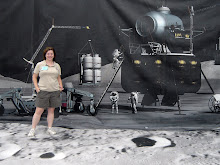
Roving the Moon (?)
The House Omnibus spending bill, which was also passed by the Senate last week, contained some pretty specific language in it:
From Senator Shelby's press release:
A couple things are playing out here. As NASA is underfunded in its ambitious Exploration program, it decided to cut the RLEP-2 lunar lander last year, saying all it needed for return to the Moon was "a good map." That might be true if you want to just land once, look around, and fly away. But this return to the Moon (we hope) will be so much more than that. The RLEP-2 mission was designed with two main objectives: characterize potential landing sites from the ground, with an eye on resources like hydrogen/water, and test critical human mission components like automated precision landing and structures.
There are a lot of ideas out there for ultra-low-cost lunar missions, like little rovers for the Google Lunar X-Prize and other small sats. I'm all for creative design of lunar micro-orbiter or micro-landers. They could send back some cool photos or movies, and it would certainly generate a lot of excitement, which is political capital. But, those class of spacecraft can't do the real tasks that scientists and engineers need as part of renewed exploration - that is, sophisticated sample analysis at multiple sites, self-similar platforms to test human lander components, and sample return. To accomplish these significant tasks, we need a more serious investment. Even if you think NASA costs are bloated, try cutting them in half. The MER rovers cost $850 to launch. Cut it in half, then half again for a single lander - you're still over $200M.
So, while RLEP-1 (aka Lunar Reconnaissance Orbiter) will get our "good map," there's still a lot of work to be accomplished by a serious lander, designed to address outstanding engineering and science goals that benefit planning across all of NASA. So keep your fingers crossed! I definitely am - combining lessons in design, operation, and public value of the MER rovers with forward-looking science and exploration goals on the Moon can't be anything but totally exciting - and why I came to work for NASA.
In 2005, NASA selected a team for the development of a lunar lander spacecraft consistent with the goals set forth in the Administration's Renewed Spirit of Discovery and the National Aeronautics and Space Administration Authorization Act of 2005 (Public Law 109155) which called for a robust lunar robotic program, including robotic lunar landers. The National Research Council's report: The Scientific Context for Exploration of the Moon further supports robotic precursor missions to the Moon's surface and the valuable scientific resource such missions will provide for returning humans to the Moon. The Appropriations Committees agree that the NASA selected mission is of critical importance for the exploration vision. For this purpose, $42,000,000 is provided for this lunar lander mission.
From Senator Shelby's press release:
The Program Management Office for NASA’s Lunar Precursor and Robotic Program (LPRP) is based at Marshall Space Flight Center. The program includes the Lunar Reconnaissance Orbiter, LCROSS and Lunar Robotics Lander missions. These missions will gather critical data for the return of the United States to the moon and the potential for a long-term presence there. The bill includes a total of $271.5 million for LPRP, of which $42 million will be for the Lunar Lander mission and another $20 million will be for the program management office for activities associated with the Marshall Space Flight Center. The LPRP management office will be directly involved in the planning and oversight of future lunar robotic missions, integrating lunar data from NASA and other international missions, oversee technology development, and lead NASA’s public outreach and education activities for understanding the lunar environment.
“The LPRP program is an invaluable tool for the scientists and engineers at NASA to determine the best course of action when returning to the moon,” said Shelby. “The President, Congress and the scientific community have repeatedly pointed out the importance of a robotic lunar lander as a precursor to manned flights to the moon. I am glad the bill recognizes this need and Marshall’s role in accomplishing it.”
A couple things are playing out here. As NASA is underfunded in its ambitious Exploration program, it decided to cut the RLEP-2 lunar lander last year, saying all it needed for return to the Moon was "a good map." That might be true if you want to just land once, look around, and fly away. But this return to the Moon (we hope) will be so much more than that. The RLEP-2 mission was designed with two main objectives: characterize potential landing sites from the ground, with an eye on resources like hydrogen/water, and test critical human mission components like automated precision landing and structures.
There are a lot of ideas out there for ultra-low-cost lunar missions, like little rovers for the Google Lunar X-Prize and other small sats. I'm all for creative design of lunar micro-orbiter or micro-landers. They could send back some cool photos or movies, and it would certainly generate a lot of excitement, which is political capital. But, those class of spacecraft can't do the real tasks that scientists and engineers need as part of renewed exploration - that is, sophisticated sample analysis at multiple sites, self-similar platforms to test human lander components, and sample return. To accomplish these significant tasks, we need a more serious investment. Even if you think NASA costs are bloated, try cutting them in half. The MER rovers cost $850 to launch. Cut it in half, then half again for a single lander - you're still over $200M.
So, while RLEP-1 (aka Lunar Reconnaissance Orbiter) will get our "good map," there's still a lot of work to be accomplished by a serious lander, designed to address outstanding engineering and science goals that benefit planning across all of NASA. So keep your fingers crossed! I definitely am - combining lessons in design, operation, and public value of the MER rovers with forward-looking science and exploration goals on the Moon can't be anything but totally exciting - and why I came to work for NASA.
Friday, December 14, 2007
What I did last week

Last Friday I gave a short talk on a panel called Forging the Future of Space Science: The Next 50 Years. It was a really fun event celebrating the 2nd International Geophysical Year. The main reason I'm aware of the first Geophysical Year in 1957 is that is when the Amundsen-Scott South Pole Station was built, establishing a long-term, permanent human presence at the center of the Antarctic continent. I've been to Antarctica twice now with the Antarctic Search for Meteorites, and I know firsthand how much amazing science about our planet - biology, oceanography, volcanology, paleontology, meteorology and climate science, and of course astrobiology and space science - are uniquely enabled by the South Pole and other Antarctic outposts providing vital support and logistics. So it's personally fitting for me to be talking about building a permanent human outpost on the Moon during the 2007 IGY.
It was fun to spend my 10 minutes gushing about the Moon. My main point is that the first time we went to the Moon, planetary science was in its infancy and we were learning how to explore another planet. The knowledge we gained from those missions gave us a framework for thinking about terrestrial planets - things we consider fundamental now, like that they are made of rocks that form through normal igneous processes, they are differentiated into a core, mantle, and crust, and impact craters extensively modified the surface. Then we happily went off, using this knowledge to explore other planets. But we never took that knowledge back to the Moon, to understand the Moon as a unique planet in its own right. The chance to have an outpost and study the lunar South Pole in the same way we've come to be able to work in Antarctica would be an amazing scientific and human accomplishment.
But, setting my 10 minutes of soapbox grandstanding aside, I had a mindblowing day, meeting some giant people who live here in Huntsville. Ernst Stuhlinger spoke first - he is one of the original von Braun rocket team, who emigrated to the US after WWII and jumpstarted the US Space PRogram here in Huntsville, and who went on to serve as associate director for MSFC. I had dinner with Jan Davis, a shuttle and space station astronaut, and Dave Williams, currently President at the University of Alabama Huntsville, but who made his career in iron meteorites and was my ANSMET tentmate Lysa's undergraduate advisor. It's a small, small world.
Saturday, December 08, 2007
Workin' on the weekend
This weekend, I'm volunteering to help move Spirit along. We've just passed the autumnal exuinox on Mars and are sliding into winter, which means the sun is getting low on the horizon and Spirit needs to start tilting toward it. The team has decided to have Spirit winter over on the north side of Home Plate, this great volcanic feature we've been investigating for a while now. We were hoping to get to more exotic territory before Spirit had to stop for the winter, but this year was compounded by the huge summer dust storms - remember when that howling wind actually cleaned the solar panels off? Well, as they say, what goes up must come down, and Mars dust is no exception. Spirit's solar panels are now coated in dust and as the amount of sun and heat declines, so does hope for dust devils. The thick coating of dust has reduced power on Spirit even in advance of the wintertime.
Adding urgency to our mission to keep Spirit safe and healthy is the fact that the rover got trapped in a sand pit on top of Home Plate for a week or so. The always-skillful rover planners extricated Spirit and now she is perched on the edge of the world - as you can see in this Navcam image. Now we're doing some short drives along the edge to map out the slopes and rocks and find a good place for Spirit to slide down the edge and achieve a pretty exciting 25 degree northerly tilt. We're hoping that the tilt and a power conserving winter plan will allow Spirit to survive the depths of a second Martian winter and go on to explore more of Mars come springtime.

The truth is, I really miss spending my time with the rovers, so I'm more than happy to come in on the weekend and get back into the guts of operations. It's also very cool that the many other people it takes to plan a rover drive sol are willing to come in on their days off to make this work. This is the second weekend in a row that the JPL engineers and the science staff came in to shepherd Spirit along. Big love to all of them!
Adding urgency to our mission to keep Spirit safe and healthy is the fact that the rover got trapped in a sand pit on top of Home Plate for a week or so. The always-skillful rover planners extricated Spirit and now she is perched on the edge of the world - as you can see in this Navcam image. Now we're doing some short drives along the edge to map out the slopes and rocks and find a good place for Spirit to slide down the edge and achieve a pretty exciting 25 degree northerly tilt. We're hoping that the tilt and a power conserving winter plan will allow Spirit to survive the depths of a second Martian winter and go on to explore more of Mars come springtime.

The truth is, I really miss spending my time with the rovers, so I'm more than happy to come in on the weekend and get back into the guts of operations. It's also very cool that the many other people it takes to plan a rover drive sol are willing to come in on their days off to make this work. This is the second weekend in a row that the JPL engineers and the science staff came in to shepherd Spirit along. Big love to all of them!
Thursday, November 29, 2007
Lunar Reconnaissance Orbiter

This week, I am up at the Goddard Space Flight Center in Maryland for a project science meeting for the Lunar Reconnaissance Orbiter (LRO). LRO is our first step toward fulfilling the Vision, that is, gaining a foothold on the Moon and using it as a stepping stone toward explanding outward.
LRO is carrying seven instruments on board to look for water, understand the radiation environment, and acquire high-resolution information on topography, temperature, roughness, slopes, and imagery to characterize potential landing sites. At this point, the instruments are all built and undergoing individual acoustic, vibrational, and thermal vacuum testing. After they have been individually tested, they will be delivered to the spacecraft integrations center in the next two months. Then they will be integrated onto the spacecraft body and the whole thing will tested together.
LRO is scheduled for launch in 2008 on an Atlas V 401 rocket. No time to delay ops concepts or calibration for the cruise phase, as LRO takes a direct flight to the Moon in four days. The spaceraft spends a year in a circular polar orbit approximately 50 km above the Moon's surface, closer than any other lunar mission. During this time, it will be making global maps and acquiring observations for ESMD that they need to start planning for landing sites. After a year, control of the spacecraft will be turned over to science and while the spacecraft is still functional it will be used for science observations, possibly including a change of orbit to a more fuel-efficient elliptical orbit.
The LPRP at MSFC (where I work) is the program management office for LRO, Goddard manages the spacecraft, like integration and operations, and the seven instruments onboard all have individual principal investigators (PIs) and science teams. This makes LRO a much different flavor of space mission than, say, the Mars Exploration Rovers where we have a single PI and one coherent team. So, the project science meeting has been great for me to meet the team members (though I already know many of them of course), meet the management, and get instrument updates. The team spent a lot of time here discussing operations scenarios for when we actually get up there. There are some interesting ways of coordinating observations among instruments to make a richer science story than just simply leaving instruments switched on on a nadir-pointing orbit. But they take some time and agreement. We also spent some time thinking about how to co-register all the data together and tie it to the new reference frame that LOLA, the laser altimeter on LRO, will provide.
It definitely got me psyched for this mission, which we hope will be the first of many robotic missions to the Moon! But wait, why do we need LRO when there are three other international lunar orbiters, anyway? Next post, I'll tell you.
Tuesday, November 20, 2007
Returning to the Moon

Hi everyone, sorry for the extended hiatus. I took a new job at the NASA Marshall Space Flight Center at the end of the summer and moved to Huntsville, AL in October. Wow! I can hardly believe it myself.
Initially, I'm here to support the Lunar Precursor Robotics Program. We'll have a new website soon that I'll point you to. We are currently serving as a conduit to understand what data the engineers need to get back to the Moon, and come up with some solutions to get them those data. We are the managers for the Lunar Reconnaissance Orbiter and Lunar CRater Observation and Sensing Satellite (LCROSS) missions, due to launch next year and return gobs of new data that will help address some engineering design issues (as well as new science of course). We are also developing an application called Lunar Mapping and Modeling, which will rapidly deliver these great new data to the users (engineers and scientists). I'm also here as a resource to other MSFC lunar activities, of which there are surprisingly many - the lunar impact monitoring group, the lunar simulant development effort, lunar dust and its effects work, and an interesting partnership with students in the UAH Mech E program to spend a semester designing a lunar lander mission. As if all that weren't enough, I'll also be working to build a lunar & planetary science group to do some great science in partnership with the opportunities afforded by exploration activities. You all know that the Moon is near and dear to my heart, so this is a very exciting opportunity for me to combine lunar science with my spacecraft experience and boundless enthusiasm to move lunar exploration forward!
Huntsville, AL is a completely pleasant community. It is powered by the Army's missile systems and Marshall's rocket propulsion, so it is full of aerospace industry branches, software and electronics companies, and other high-tech employers. It is a small town but populated by international and well-educated people. I'm already a member of a great NPR radio affiliate, the Huntsville Museum of Art, the Huntsville Botanical Gardens, a fantastic little pottery studio, and the amazing U.S. Space and Rocket Center (no, I never went to Space Camp). The photo above is the first one I took in Huntsville. It's a Saturn V rocket (replica) and the Moon. How cool is that ?! We also have a real Saturn V, but it is now exclosed in a protected building at the lower right of this photo. One of the greatest things about moving here is that the whole community is jazzed about the space program and going to the moon. When I meed people and tell them I am a lunar scientist, they are wowed and happy that I am here helping the program. It's pretty amazing support for me, my science, and my career actually. Let's go to the Moon!!!!!!!
Wednesday, September 12, 2007
Toe-dip

Hi all, there's obviously lots going on that I'll need to catch you up on at some point. Both rovers are on the move again as the dust storms abate and they gain power back. Spirit is up on top of Home Plate finally, and heading south across the top. Opportunity is going into Victoria Crater!! We did a toe-dip maneuver on Monday, which was to assess the trafficability and the rover's ability to maneuver down the slope and to take pictures of what a good route down might be. Here's a tiny movie of the toe-dip navcam images that show all is well and we are excited!!
Friday, August 10, 2007
The record-holder (without steroids)
Today, Spirit reaches Sol 1281, which matches the lifetime of the Viking II Lander (late 70s-early 80s) on the surface of Mars. Tomorrow it will be the all-time champion! And all on solar power! Go Spirit!
Both rovers have survived the worst part (we hope) of the current dust storms. The opacity of the air is no longer climbing, there are no new storms forming, and the solar power is holding steady. In the coming weeks and months we expect the dust to settle (though hopefuly not all on our solar panels) and activities will resume. It is a good thing the first storm gusts cleaned both rovers' solar panels! Opportunity is holding tight, keeping warm enough and keeping her batteries mostly charged. We've been able to do some atmospheric monitoring, but not much else. Spiritspide it's been more interesting.
 Around sol 1257 the winds were howling at their worst. Here's an animation (from Larry Crumpler) of two microscopic images the rock Spirit has been parked over for the storm. It is a bit of silica-rich rock we've been trying to characterize, so it's light-toned and rough. The darker part is the dark basaltic soil and sand in the area. These two images were taken 7 minutes apart. If you look carefully, you can actually see sand grains moving around all over the place. Estimates of the wind velocity are between 60 and 70 miles per hour to get that type of motion on particles that large. (The images are 31 mm across, for scale).
We've also been monitoring the motion of sand on the ground. Here's an image in front of Spirit showing ripples crawling along and one behind Spirit showing her tracks get obliterated by the wind.


Both rovers have survived the worst part (we hope) of the current dust storms. The opacity of the air is no longer climbing, there are no new storms forming, and the solar power is holding steady. In the coming weeks and months we expect the dust to settle (though hopefuly not all on our solar panels) and activities will resume. It is a good thing the first storm gusts cleaned both rovers' solar panels! Opportunity is holding tight, keeping warm enough and keeping her batteries mostly charged. We've been able to do some atmospheric monitoring, but not much else. Spiritspide it's been more interesting.
 Around sol 1257 the winds were howling at their worst. Here's an animation (from Larry Crumpler) of two microscopic images the rock Spirit has been parked over for the storm. It is a bit of silica-rich rock we've been trying to characterize, so it's light-toned and rough. The darker part is the dark basaltic soil and sand in the area. These two images were taken 7 minutes apart. If you look carefully, you can actually see sand grains moving around all over the place. Estimates of the wind velocity are between 60 and 70 miles per hour to get that type of motion on particles that large. (The images are 31 mm across, for scale).
We've also been monitoring the motion of sand on the ground. Here's an image in front of Spirit showing ripples crawling along and one behind Spirit showing her tracks get obliterated by the wind.


Tuesday, July 31, 2007
more web diversions

No matter how many different tests I take, how many questions they have, or what the questions are, I always turn out INTJ. Sigh.
Monday, July 30, 2007
Dark days
Despite my asking the HiRISE team to find and kill an apparent background process called HiOPACITY (heh, geek humor), the dust storms continue to give the rovers a tought time. Spirit experienced a record high tau of 4.738 on Sol 1265 with a corresponding solar array energy of 261 watt-hours. The most recent tau for Spirit on Sol 1269 was 4.322 with a solar array energy of 274 watt-hours.
Spirit still remains power positive, but things are tougher for Opportunity on the other side of the planet. Because we have been saving energy on Opportunity by not making science observations, the rover isn't generating waste heat. The waste heat normally goes into heating up the electronics box to keep the electronics warm. No activities means no waste heat means the temperature is dropping in the electronics box, about 1 degree C per sol. At a certain point, the rover will automatically turn on emergency heaters for the electronics, but they suck up a lot of power - power that Opportunity doesn't have right now. So we're now trying to strike a balance by having the rover stay on longer each sol to expend more heat, raising the electronics temperatures and avoiding the survival heater turn on. But the price is that the rover will now start draining power and risks tripping a low-power fault sometime during this plan.
When a low-power fault is tripped, the rover's systems take the batteries off-line putting the rover to sleep and then checking each sol to see if there is sufficient available energy to wake up and perform communications. If there is not sufficient power, Opportunity will stay asleep. Depending on the weather conditions Opportunity could stay asleep for days, weeks or even months, all the while trying to charge her batteries with whatever available sunlight there might be. At this point the ground team will be unable to help and Opportunity would be completely on her own. When skies clear Opportunity would wake up and service her normal communication passes (if within about 5 weeks) or listen each day to see if we are there trying to talk to her (if beyond about 5 weeks).
Oooooh, hang on little rover!!!!!!
Spirit still remains power positive, but things are tougher for Opportunity on the other side of the planet. Because we have been saving energy on Opportunity by not making science observations, the rover isn't generating waste heat. The waste heat normally goes into heating up the electronics box to keep the electronics warm. No activities means no waste heat means the temperature is dropping in the electronics box, about 1 degree C per sol. At a certain point, the rover will automatically turn on emergency heaters for the electronics, but they suck up a lot of power - power that Opportunity doesn't have right now. So we're now trying to strike a balance by having the rover stay on longer each sol to expend more heat, raising the electronics temperatures and avoiding the survival heater turn on. But the price is that the rover will now start draining power and risks tripping a low-power fault sometime during this plan.
When a low-power fault is tripped, the rover's systems take the batteries off-line putting the rover to sleep and then checking each sol to see if there is sufficient available energy to wake up and perform communications. If there is not sufficient power, Opportunity will stay asleep. Depending on the weather conditions Opportunity could stay asleep for days, weeks or even months, all the while trying to charge her batteries with whatever available sunlight there might be. At this point the ground team will be unable to help and Opportunity would be completely on her own. When skies clear Opportunity would wake up and service her normal communication passes (if within about 5 weeks) or listen each day to see if we are there trying to talk to her (if beyond about 5 weeks).
Oooooh, hang on little rover!!!!!!
Saturday, July 14, 2007
Dust bedevils Mars
I've been having a great couple of weeks with a MER team meeting and the 7th International Conference on Mars (ok, it was *about* Mars, not *on* Mars, sadly). A MER team meeting is a really fun thing to attend. First of all, the scientific team is pretty large, when you tally up the principal investigators, their postdocs and students, and technical staff support. We're spread out over the US, Canada, Germany, Denmark, and France, so we don't see each other much except for conferences. So a MER team meeting gives us all the chance to catch up on what we're all doing science-wise. Team members give talk about what they are thinking about these data on those rocks, or the results from those soil experiments we did, etc. and then everyone gets to ask whatever zany questions they think of. Unlike at a larger conference, people don't feel as self-conscious about thinking out loud, and it's a wonderful sounding board to toss ideas around and have the whole team's expertise brought to bear. Not surprisingly, the hot topic at this meeting were the high-silica story emerging near Home Plate. Do the high-Si rocks occur in conjunction with the high-sulfur soils? Are they remnants of fumaroles or hot springs? How could volcanic activity nearby at Home Plate have contributed? When did all these form? Could we be looking at the most habitable place on Mars we've ever seen? Fun stuff!
While the science team was debating, the rovers weren't doing very much. For the last couple of weeks, there have been some massive dust storms on Mars, accompanied by some alarmist headlines, like "Martian dust storm could destroy rovers" and "Mars dust storms suck life out of rovers". Yes, it's scary for our little dudes, but they're not dead yet. Check out this JPL video discussing the storms and the mission.
Dust storms on Mars are a common thing. They actually appear in cycles, every few years there seems to be a period of increased dust storm activity, and sometimes the entire planet can be enveloped by swirling dust. The storms start when the ground and atmosphere heat up during the change of seasons. This thermal energy causes winds to blow, and the wind lofts the fine Martian dust. The individual storms can be long-lived, similar to hurricanes on Earth, where an individual storm can last for weeks.

Underneath the storm, sunlight is blocked from entering by the opaque dust. In the image above, you can see the sky over Opportunity get darker and darker. This is a problem for the rovers, because they generate their own power using solar panels. Fully clean solar panels on each rover can generate about 800 Watt-hours per sol. That's enough to light one 100-watt light bulb for 8 hours. That is also enough to operate all our tiny instruments that look at the sky and the ground, drill into rocks, and measure elements and minerals. The dust storms have reduced the amount of sunlight getting to the ground to something like 1% of normal, so that diminishes the rovers' ability to generate energy for themselves.
In terms of science, it's perfectly ok for us to give the little dudes a break and tell them just to sit tight until the storms dissipate. Of course, we are anxious, with Opportunity perched right on the edge of Victoria Crater and Spirit just about to drive up onto Home Plate, but we want these vehicles to continue to work so we don't have to push them. The real issue is how much power does it take to stay alive? The Martian surface is really really cold, which is really really bad for electronic parts. The fear is that if the rovers don't have enough power to keep their heaters on, the electronics will freeze and break, and then it's anyone's guess whether we can still operate them. Fortunately, for Opportunity, which is experiencing the worst of it, it is the height of summer (warm), near the equator (warm), and under an insulating dust blanket (warm), so the amount of power it needs to stay warm is significantly less than it might be at other times. The engineering and science teams worked hard last week to make a low-power plan for Opportunity, where it just tries to keep itself warm, and we had telemetry today that indicates it is working well. Unfortunately, we'll only hear from the rover every 3 days or so, so that keeps everyone on edge.
But other Mars missions are on the case. You can see images of the dust cover and storm activity with THEMIS and MARCI. Also some people are actually interested in dust storms on Mars and for them they've got their instruments going full blast. We're just keeping our fingers crossed for the weather and working hard on the ground to keep this mission going a little while longer.
While the science team was debating, the rovers weren't doing very much. For the last couple of weeks, there have been some massive dust storms on Mars, accompanied by some alarmist headlines, like "Martian dust storm could destroy rovers" and "Mars dust storms suck life out of rovers". Yes, it's scary for our little dudes, but they're not dead yet. Check out this JPL video discussing the storms and the mission.
Dust storms on Mars are a common thing. They actually appear in cycles, every few years there seems to be a period of increased dust storm activity, and sometimes the entire planet can be enveloped by swirling dust. The storms start when the ground and atmosphere heat up during the change of seasons. This thermal energy causes winds to blow, and the wind lofts the fine Martian dust. The individual storms can be long-lived, similar to hurricanes on Earth, where an individual storm can last for weeks.

Underneath the storm, sunlight is blocked from entering by the opaque dust. In the image above, you can see the sky over Opportunity get darker and darker. This is a problem for the rovers, because they generate their own power using solar panels. Fully clean solar panels on each rover can generate about 800 Watt-hours per sol. That's enough to light one 100-watt light bulb for 8 hours. That is also enough to operate all our tiny instruments that look at the sky and the ground, drill into rocks, and measure elements and minerals. The dust storms have reduced the amount of sunlight getting to the ground to something like 1% of normal, so that diminishes the rovers' ability to generate energy for themselves.
In terms of science, it's perfectly ok for us to give the little dudes a break and tell them just to sit tight until the storms dissipate. Of course, we are anxious, with Opportunity perched right on the edge of Victoria Crater and Spirit just about to drive up onto Home Plate, but we want these vehicles to continue to work so we don't have to push them. The real issue is how much power does it take to stay alive? The Martian surface is really really cold, which is really really bad for electronic parts. The fear is that if the rovers don't have enough power to keep their heaters on, the electronics will freeze and break, and then it's anyone's guess whether we can still operate them. Fortunately, for Opportunity, which is experiencing the worst of it, it is the height of summer (warm), near the equator (warm), and under an insulating dust blanket (warm), so the amount of power it needs to stay warm is significantly less than it might be at other times. The engineering and science teams worked hard last week to make a low-power plan for Opportunity, where it just tries to keep itself warm, and we had telemetry today that indicates it is working well. Unfortunately, we'll only hear from the rover every 3 days or so, so that keeps everyone on edge.
But other Mars missions are on the case. You can see images of the dust cover and storm activity with THEMIS and MARCI. Also some people are actually interested in dust storms on Mars and for them they've got their instruments going full blast. We're just keeping our fingers crossed for the weather and working hard on the ground to keep this mission going a little while longer.
Monday, June 25, 2007
Dust devils on Mars and New Mexico

Sorry for the hiatus - I'm traveling quite a bit this summer. This week, literally jet-setting at the JETSET summer school in the Açores, where R is one of the invited lecturers and I'm just tagging along for the week. We're on São Miguel Island, it's raining, he's lecturing, and I'm working. Later in the week we'll have a look around at the volcanic features of this island, which is one of several here at the triple junction of the African, Eurasian, and North American plates in the middle of the Atlantic Ocean. North America, Europe and Africa are all moving away from each other and spreading is occuring along the rifts in between the plates - producing the volcanoes that make up the Açores. All of the islands are still geologically active; the last eruption on São Miguel was in the 1600s. There are hot springs and other geothermal features here, plus the islands get much of their energy from geothermal plants - how cool is that?!
While I've been traveling around, Spirit has been putzing around the northeastern part of Home Plate. We traversed up the side to get the stratigraphy, then came down again to revisit the silica-rich targets of Silica Valley - as shown in this false-color image, the nubby Si-rich rocks seem to be underlying the valley rather extensively. I know those of you following along at home see pictures of Home Plate, then Silica Valley, then Home Plate, then back again, etc. and it's probably hard to figure out what the team is planning to do! Truthfully, the plan is guided by what the rover sees and how long it takes the team to process the information. So while we have a long-term plan to get up on top of Home Plate and head south, we keep seeing interesting things nearby and want to take the time to investigate them before leaving the area permanently. Better to backtrack 10m now then miss out on important science later!
But putzing around one area has had its benefits - particularly lying in wait for dust devils. Both rovers regularly monitor the Martian atmosphere, like little weather stations on the surface. They keep track of the opacity of the atmosphere by seeing how much light is let in at specific times of day and the team can translate that into how much dust is in the atmosphere. They have sequences that look for clouds in the Martian mornings. We are also tracking the percentage of argon in the atmosphere, which is related to atmospheric pressure - a funny thing about Mars is that the atmospheric pressure is small, so when carbon dioxide condenses or sublimes at the polar caps, the entire atmosphere deflates or inflates a little bit, changing the percrntage of other gases like argon. Most interesting on a day-to-day basis are the dust devils, which are small vortices of hot air rising from the ground and carrying fine particles of dust and sand. Here's a great article about dust devils on Mars.
 Because the atmosphere is thin, the dust devils don't have a lot of pressure in them, so they can't do anything like tip the rovers over. But they can blow dust around - and off the solar panels of the rover as seen in this true-color image of Spirit's solar panel from sol 1231! The solar panels on the rover are flat to be able to catch maximum sun rays. But this also means dust settles on them from normal operations. The design team know this would happen and in fact it was one of the contributing factors to the expected rover lifetime - that the solar panels would dust up and not be able to generate any more power. But unexpected dust devils have come along every so often and blown the dust off of both rovers and allowed them to keep on generating energy for themselves. Spirit hasn't had its solar panels cleaned since sol 420, more than two Earth years ago, and was pretty dirty. But in the last few weeks, Spirit has been buffeted by at least two dust devils and is now generating as much power as her frequently-cleaned sister, Opportunity. In fact, because of a large dust storm on Mars affecting Opportunity, this week Spirit is actually outperforming Opportunity in energy generation!
To people living in the American southwest, dust devils are a familiar sight and form in the same way as on Mars, though because of the denser atmosphere, terrestrial dust devils aren't necessarily gentle. I had the good fortune recently to witness a highly unusual dust devil phenomenon about 10 km from my own house! The rising warm air from the ground forms the dust devil funnel, and the sinking cold air from the low-hanging clouds gets sucked into the vortex, creating a full funnel cloud. R and I witnessed this for about 15 minutes, seeing the dust on the ground rise up toward the clouds and the peculiar limb-darkening of the upper funnel. The ground speed was only about 60 mph and it did no damage, unlike a true tornado (fortunately for me and my tornado-phobia!). Eventually the ground funnel moved so far from the connecor in the clouds that the thin funnel broke apart and the whole thing collapsed. I'll never forget one of the things I learned in Randy Jokipii's planetary physics class during my first semester of grad school - the mathematics of vortex formation are such that they are impossible to start, but once started are impossible to stop - and are therefore, by nature, random events. Cool!

Tuesday, June 12, 2007
Water on Mars?
Hey Science Girl, any comments on this story? Sure, my comment is: don't believe it - it was retracted, chiefly because the rocks in the photos are actually on the inside of a crater on a 20-30 degree slope. Scientists can make mistakes. But it does bring up a good opportunity to talk about false-color images!
Many of the rover pictures, and other planetary photos, appear in "false color." We're used to looking with our eyes and seeing all the colors at once. But you've done the experiment where you pass light through a prism and make a rainbow, right? That shows you that the light we see, whether in a source like the sun or reflected off objects, is made of light of many wavelengths. Something that looks green to your eye is reflecting a lot of 510-nanometer light back to you (green), and not so much 650-nanometer light (red). The MER camera - Pancam - only sees one color at a time. Basically, it has filters that only let a specific wavelength of light through, so it takes a grayscale photo showing the intensity of the scene in one color - or filter - at a time. The Pancam has 13 different filters, which means it can see the scene in 13 different wavelengths. Some of the wavelengths are familiar to us, like blue and red, and others are beyond human vision, like infrared.
When we humans get the data, each photo is a grayscale image taken at a different wavelength. If we had an infinite number of filters that covered the whole visible spectrum, we could combine them into what our eyes would see. But instead we have to be a little more clever and combine the filters in combinations to approximate what our eyes would see. These are called "approximate true color" or "true color" images. When you look at Mars in true color, you see that it's pretty much red. The rocks are red, the soil is red, the dust is red, even blueberries are red. It's pretty hard to make out differences in true color. So, we get tricky and make "false-color" images, where we combine filters in ways the eye would never see in order to bring out differences among rocks and soils and features. For example, many geologic features are distinct in the Pancam filters L2, L5 and L7, which correspond to wavelengths of 753, 535, and 432 nm, or infrared, greenish-yellow, and indigo. These get combined so L2 represents red, L5 represents green, and L7 represents blue - meaning that much of the visible red wavelengths that dominate all of Mars are missing in this representation and the blues become more prominent.
 Now let's look at the photo in the article again, knowing now it is in false color (L257 actually). The blue in this photo means the material reflects more 432 nm light than 535 and 753 nm light, making it appear blue. We can't tell from this image whether our eye would actually see it as some other color. In fact, when we look at the true-color images of the area where this picture comes from (Burns Cliff), we can see that in fact, the "blue" stuff in the cracks reflects a LOT of red light, appearing reddish brown when we're able to collect images using the red filter. We can also see the slope of the area, making it impossible for water to pool.
False-color images are really useful for a couple of reasons. They allow us to take less data and still have a reasonable sampling of the target in wavelenghts that span our available filters. They allow us to discriminate more readily amonf the reddish rocks of Mars, including the famous blueberries, which are actually grayish-red hematite. And, when combined in less intuitive ways, they can make some really spectacular and colorful and amazing views of another planet.
Many of the rover pictures, and other planetary photos, appear in "false color." We're used to looking with our eyes and seeing all the colors at once. But you've done the experiment where you pass light through a prism and make a rainbow, right? That shows you that the light we see, whether in a source like the sun or reflected off objects, is made of light of many wavelengths. Something that looks green to your eye is reflecting a lot of 510-nanometer light back to you (green), and not so much 650-nanometer light (red). The MER camera - Pancam - only sees one color at a time. Basically, it has filters that only let a specific wavelength of light through, so it takes a grayscale photo showing the intensity of the scene in one color - or filter - at a time. The Pancam has 13 different filters, which means it can see the scene in 13 different wavelengths. Some of the wavelengths are familiar to us, like blue and red, and others are beyond human vision, like infrared.
When we humans get the data, each photo is a grayscale image taken at a different wavelength. If we had an infinite number of filters that covered the whole visible spectrum, we could combine them into what our eyes would see. But instead we have to be a little more clever and combine the filters in combinations to approximate what our eyes would see. These are called "approximate true color" or "true color" images. When you look at Mars in true color, you see that it's pretty much red. The rocks are red, the soil is red, the dust is red, even blueberries are red. It's pretty hard to make out differences in true color. So, we get tricky and make "false-color" images, where we combine filters in ways the eye would never see in order to bring out differences among rocks and soils and features. For example, many geologic features are distinct in the Pancam filters L2, L5 and L7, which correspond to wavelengths of 753, 535, and 432 nm, or infrared, greenish-yellow, and indigo. These get combined so L2 represents red, L5 represents green, and L7 represents blue - meaning that much of the visible red wavelengths that dominate all of Mars are missing in this representation and the blues become more prominent.
 Now let's look at the photo in the article again, knowing now it is in false color (L257 actually). The blue in this photo means the material reflects more 432 nm light than 535 and 753 nm light, making it appear blue. We can't tell from this image whether our eye would actually see it as some other color. In fact, when we look at the true-color images of the area where this picture comes from (Burns Cliff), we can see that in fact, the "blue" stuff in the cracks reflects a LOT of red light, appearing reddish brown when we're able to collect images using the red filter. We can also see the slope of the area, making it impossible for water to pool.
False-color images are really useful for a couple of reasons. They allow us to take less data and still have a reasonable sampling of the target in wavelenghts that span our available filters. They allow us to discriminate more readily amonf the reddish rocks of Mars, including the famous blueberries, which are actually grayish-red hematite. And, when combined in less intuitive ways, they can make some really spectacular and colorful and amazing views of another planet.
Friday, June 08, 2007
Silica Valley

You might have seen this Press Release last week describing a little patch of soil that turned out to be a really incredible find. Since Spirit's right front wheel stopped working, the rover drives backwards dragging the stuck wheel around. When there's soft soil or dust, this effectively digs a small trench and churns up subsurface material. Most times, the soil on Mars (that's soil in the planetary sense - no organics like soil on Earth) is pretty uniform and looks the same from place to place to place. Sometimes though, Spirit has turned up light-colored material like Tyrone, Arad, and Paso Robles. Those bright materials have turned out to be sulfate salts - generally Ca-sulfate (gypsum) - which forms on Earth as a precipitate from liquid water. Those deposits show us that liquid water played a role here in the soils somehow, maybe as a shallow lake or ephemeral playa (not too different from New Mexico actually).
As we headed to Home Plate, Spirit's wheel churned up another bright patch. By this point, most of the team wasn't freaking out about every white patch and it was actually the APXS team leader who pointed it out and asked for a picture. When we looked at it in Pancam color and with the Mini-TES, it was immediately clear it was something new. The Mini-TES is a remote-sensing instrument that collects light in the near-infrared spectrum, beyond where our eyes can see. The TES stands for Thermal Emission Spectrometer. You've probably seen infrared cameras on TV, and we just had someone come up and image our home in infrared to detect water leaks, and the TES works in a siliar way - it passively collects thermal emission from the objects around it. The shape of the thermal emission spectrum reflects the mineralogy of the rock, so we use Mini-TES to remotely sense the mineral makeup of nearby rocks. When Mini-TES looked at the white patch, it showed something totally new - the presence of free SiO2.
SiO2 is silica or silicon dioxide, better known on Earth as quartz, sand, opal, chert, amethyst, jasper, or agate, just to name a few. If you're a rockhound, you know that quartz minerals form where there's lots of water, like fluids flowing through a vein or vapors depositing on springs. We took better Mini-TES spectra to distinguish what form the SiO2 was in and it looks most like opal, which means the SiO2 is not like quartz crystals but rather kind of amorphous, more like deposits found at hot springs. So that's not to say there was a hot spring here, but since we're right next to Home Plate - a structure we think was caused by hot lava interacting with groundwater - we really think they might be linked!
OK, that's cool you think, but why the heck do we need to put a press release every time there's something that might be water-related? Well, first it *is* kind of cool. No other mission has ever found anything like SiO2, even though it's been speculated to exist for decades. Second, remember that this continues to be a publicly-funded mission and continues to fullfill its objectives. Every public program needs to report its progress - you can be cynical in saying it's to continue to get funding, and while obviously I adore working on this mission, I would find funding somewhere else, so I'll take the non-cynical view that we have an enthusiasm as well as an obligation in reporting to the public all the good things we're doing, as do all missions.
Wednesday, May 23, 2007
When the heck are you going into Victoria Crater already?!?!
OK, I've gotten that question more than once - in hallways, by email, on the phone. You've probably noticed on the rover traverse maps that Opportunity got to the dark streaks, then turned around and headed back past the Valley Without Peril. No, the valley did not live up to its name, presenting some very steep slopes that were a little bit scary to contemplate. We're headed back the way we came, to the very first valley called Duck Bay. Still no guarantees we'll go in - depends on a thorough assessment of the rover's health and the safety situation when we arrive - but the tentative plan is to make a "toe-dip" into the crater there, as the gently-sloping valley appears to be lined with bedrock for some ways into the crater.
Of course, when we arrived here at this huge hole in the ground, like all good adventurers we immediately want to leap into it. But in the trek around Victoria Crater, we've learned tons about the crater and its interior and sharpened our idea of what science can only be done by entring into the crater. For instance, this and other gorgeous Pancam images show that the bottom of the crater is covered with rippled black sand. Big sand dunes are unfriendly rover territory, as exampled by Purgatory Dune where Opportunity was stuck for 5 weeks in 2005. So, driving across the bottom of the crater is right out. But, then we went over to where that dark sand is streaming out of the crater and examined it from a safe vantage point. So we got the science along with the safety in that case.

One of the more visibly fascinating things to see is the rock that makes up the cliff faces of the crater rim, like above in one of my favorite false-color images. We think it is pretty clear that the stuff at the top is normal Meridiani surface rocks, jumbled up as ejecta blocks. But then there's some thin and thick layering, followed by spectacularly crossbedded rocks underneath those. Crossbedding is an indicator of sedimentary processes operating in a fluid environment (here I'm using fluid to mean either wind or water, can't tell which yet) forming dunes and ripples. I was going to try to explain it more, but here's a *fantastic* animation showing how crossbeds form. Though it would be da bomb to drive up to the crossbeds and put the Microscopic Imager right on them, we don't want the rover to tumble to its death extending a giant lever arm on a slope. So, we're doing a lot of what's called superresolution imaging of the cliff faces - taking multiple images from the same location but offset a fraction of a pixel. This allows you to combine the information and subsample below the pixel size, sharpening up edges in the image. We're getting some fantastic views of the stratigraphy this way.
But still, everyone wants to go into the crater, of course! The one thing we can't do anywhere else is understand the relationships between mineralogy, chemistry, texture, and physical properties of the rocks (like hardness or flakiness) in situ. That's why the paved valley of Duck Bay is extra attractive. When Opportunity went into Endurance Crater, we stopped to examine all the rock layers going in, leaving a trail of RAT holes behind. We hope we can do something similar here at Victoria if we get the ok to go in, so stay with us on our trek back!
Of course, when we arrived here at this huge hole in the ground, like all good adventurers we immediately want to leap into it. But in the trek around Victoria Crater, we've learned tons about the crater and its interior and sharpened our idea of what science can only be done by entring into the crater. For instance, this and other gorgeous Pancam images show that the bottom of the crater is covered with rippled black sand. Big sand dunes are unfriendly rover territory, as exampled by Purgatory Dune where Opportunity was stuck for 5 weeks in 2005. So, driving across the bottom of the crater is right out. But, then we went over to where that dark sand is streaming out of the crater and examined it from a safe vantage point. So we got the science along with the safety in that case.

One of the more visibly fascinating things to see is the rock that makes up the cliff faces of the crater rim, like above in one of my favorite false-color images. We think it is pretty clear that the stuff at the top is normal Meridiani surface rocks, jumbled up as ejecta blocks. But then there's some thin and thick layering, followed by spectacularly crossbedded rocks underneath those. Crossbedding is an indicator of sedimentary processes operating in a fluid environment (here I'm using fluid to mean either wind or water, can't tell which yet) forming dunes and ripples. I was going to try to explain it more, but here's a *fantastic* animation showing how crossbeds form. Though it would be da bomb to drive up to the crossbeds and put the Microscopic Imager right on them, we don't want the rover to tumble to its death extending a giant lever arm on a slope. So, we're doing a lot of what's called superresolution imaging of the cliff faces - taking multiple images from the same location but offset a fraction of a pixel. This allows you to combine the information and subsample below the pixel size, sharpening up edges in the image. We're getting some fantastic views of the stratigraphy this way.
But still, everyone wants to go into the crater, of course! The one thing we can't do anywhere else is understand the relationships between mineralogy, chemistry, texture, and physical properties of the rocks (like hardness or flakiness) in situ. That's why the paved valley of Duck Bay is extra attractive. When Opportunity went into Endurance Crater, we stopped to examine all the rock layers going in, leaving a trail of RAT holes behind. We hope we can do something similar here at Victoria if we get the ok to go in, so stay with us on our trek back!
Wednesday, May 16, 2007
What is up with the lunar robotic program?
Check out this great explanation of the state of the lunar robotic program from InterplanetSarah. I couldn't agree more - if Congress wants NASA to explore the Moon, Congress needs to give NASA the money to do so, and then let NASA do it. LRO will go in 2009 and human landings are scheduled for 2018 - what will we be doing at the moon in the interim? It's the perfect opportunity to show we can land on another planet robotically and retrieve samples, and learn more about the environment we're sending humans into to boot.
Tuesday, May 15, 2007
Meteorite Mania: the followup
This week, we find out that the object that crashed through that house in New Jersey is not a meteorite. When a test for nickel was conducted at the American Museum of Natural History, it turned out to be made of a human-made stainless steel alloy. So, density and magnetism are good indicators for meteorite, but they are also properties of many, many chunks of rock, ore, and slag here on Earth.
In fact, the most definitive test of the meteoritic origin of metal is the nickel content. When the Earth differentiated, forming a crust, mantle, and core, nearly all the iron, nickel, gold, platinum, and other metallic elements went into the core. That's why there aren't big chunks of metal in the crust. The metal we get through ores is in small quantities and usually collected in mineral form, which is why they are scarce and valuable. The process of smelting can convert the ore iron into its metallic form, but there won't be any nickel associated with it. Now, the same differentition happened on some large asteroids - but the iron meteorites come from the asteroid core itself, where all the metals went. So the iron in meteorites contains a lot of nickel - usually 5% but up to 35% - plus traces of lots of other metals. No rock on Earth has all the metals wrapped up into one. Even further, the iron and nickel in some iron meteorites cooled slowly from the molten state and formed two different minerals, kamacite (low-Ni) and taenite (high-Ni), and you can see these mineral crystals in the meteorite when you etch a cut surface (called Widmanstatten pattern). No rocks but meteorites have slowly-cooled Fe,Ni minerals in them. But to be able to tell Ni content and Widmanstatten pattern, you need to open the rock up and run some tests on it. So density and magnetism aren't the whole story.
Want more information on how you can tell if you have a meteorite? Glad you asked. Also, see more about metal in meteorites, including nice photos.
In fact, the most definitive test of the meteoritic origin of metal is the nickel content. When the Earth differentiated, forming a crust, mantle, and core, nearly all the iron, nickel, gold, platinum, and other metallic elements went into the core. That's why there aren't big chunks of metal in the crust. The metal we get through ores is in small quantities and usually collected in mineral form, which is why they are scarce and valuable. The process of smelting can convert the ore iron into its metallic form, but there won't be any nickel associated with it. Now, the same differentition happened on some large asteroids - but the iron meteorites come from the asteroid core itself, where all the metals went. So the iron in meteorites contains a lot of nickel - usually 5% but up to 35% - plus traces of lots of other metals. No rock on Earth has all the metals wrapped up into one. Even further, the iron and nickel in some iron meteorites cooled slowly from the molten state and formed two different minerals, kamacite (low-Ni) and taenite (high-Ni), and you can see these mineral crystals in the meteorite when you etch a cut surface (called Widmanstatten pattern). No rocks but meteorites have slowly-cooled Fe,Ni minerals in them. But to be able to tell Ni content and Widmanstatten pattern, you need to open the rock up and run some tests on it. So density and magnetism aren't the whole story.
Want more information on how you can tell if you have a meteorite? Glad you asked. Also, see more about metal in meteorites, including nice photos.
Thursday, May 10, 2007
Meteorite mania
OK, here's a couple of meteorite topics for today:
Did a meteorite fall from the recent Kansas tornado? I have a pretty intense tornado-phobia, so my heart goes out to the residents of Greensburg, Kansas and everyone who is helping them recover from the massive tornado that struck this week. But tornadoes have nothing to do with meteorites. In this case, part of the massive Brenham pallasite, which was found nearby in 1949, was on display in the Greensburg Big Well Museum. The Museum was one of the buildings destroyed in the massive tornado, but contrary to some reports out there that the 1000-lb Brenham chunk was blown away and recovered east of Greensburg or in some farmer's field, the meteorite was in fact recovered in the rubble of the destroyed museum building. No flying meteorites associated with the tornado.
Riddle me this Science Girl: What is up with the meteorite that crashed into the house in New Jersey? Hmm, I was out in the frozen wasteland when this happened, but it was apparently thought to be a meteorite that week by the group at Rutgers. The news articles only say that the Rutgers group considered the density and magnetism of the sample and haven't been able to do a definitive test for nickel concentration, the true fingerprint of an iron meteorite, so there may be more news coming. Up to 100 fist-sized meteorites fall to Earth every year, so that part isn't unusual. The majority of meteorites that fall are ordinary chondrites, so a falling iron is unusual. The chances of a meteorite falling into a piece of your property are remote - there's only a few accounts of that ever happening anywhere. So though the meteorite itself may not be scientifically spectacular, the circumstances (fresh fall, iron meteorite, human interest story) are highly unusual and are likely to drive the price up for collectors (the piece of crap car that was hit by the Peekskill meteorite went on tour and eventually sold for $12K!).
 Finally, I've very pleased to announce our new UNM Meteorite Museum web pages, including a Virtual Tour of our collection, photos of hand specimens and thin sections, tons of information about meteorites and their parent bodies, and links to our collections catalog. The information level is aimed pretty low because our physical audience at the Museum is mostly gradeschool field trips, but you might find it interesting anyway!
Did a meteorite fall from the recent Kansas tornado? I have a pretty intense tornado-phobia, so my heart goes out to the residents of Greensburg, Kansas and everyone who is helping them recover from the massive tornado that struck this week. But tornadoes have nothing to do with meteorites. In this case, part of the massive Brenham pallasite, which was found nearby in 1949, was on display in the Greensburg Big Well Museum. The Museum was one of the buildings destroyed in the massive tornado, but contrary to some reports out there that the 1000-lb Brenham chunk was blown away and recovered east of Greensburg or in some farmer's field, the meteorite was in fact recovered in the rubble of the destroyed museum building. No flying meteorites associated with the tornado.
Riddle me this Science Girl: What is up with the meteorite that crashed into the house in New Jersey? Hmm, I was out in the frozen wasteland when this happened, but it was apparently thought to be a meteorite that week by the group at Rutgers. The news articles only say that the Rutgers group considered the density and magnetism of the sample and haven't been able to do a definitive test for nickel concentration, the true fingerprint of an iron meteorite, so there may be more news coming. Up to 100 fist-sized meteorites fall to Earth every year, so that part isn't unusual. The majority of meteorites that fall are ordinary chondrites, so a falling iron is unusual. The chances of a meteorite falling into a piece of your property are remote - there's only a few accounts of that ever happening anywhere. So though the meteorite itself may not be scientifically spectacular, the circumstances (fresh fall, iron meteorite, human interest story) are highly unusual and are likely to drive the price up for collectors (the piece of crap car that was hit by the Peekskill meteorite went on tour and eventually sold for $12K!).
Finally, I've very pleased to announce our new UNM Meteorite Museum web pages, including a Virtual Tour of our collection, photos of hand specimens and thin sections, tons of information about meteorites and their parent bodies, and links to our collections catalog. The information level is aimed pretty low because our physical audience at the Museum is mostly gradeschool field trips, but you might find it interesting anyway!
Wednesday, May 09, 2007
Science results at Home Plate
Last week, we published the results of last fall's science campaign at Home Plate, including the evidence for and against a couple of our hypotheses for its formation - see the Science article here (most people need a subscription to download the full article online, but you can also visit your library or bookstore to see it in print). I love alphabetical order sometimes - I get to be 4th author on this Athena team publication :)
If you've been following along, you'll already know we think it is a volcanic feature formed when lava met wet terrain, like a maar volcano (hey! Maars on Mars!). If lava interacts with groundwater, the water can flash into steam and make shallow eruptions. These eruptions don't make normal volcanic cones, but looke like low rings or craters. Zuni Salt Lake in New Mexico is a well-preserved example of a maar, which is why it was a stop on our MER field trip last summer. Check out team intern Megan Ennis' terrific poster comparing Zuni Salt Lake to Home Plate to see some of the interesting and diagnostic features of each.
 It's good to keep an open mind among the team, though, and we're doing all a lot of new work with the rover to look for more evidence that would help us rule scenarios in or out. For instance, one of the things many people find compelling is this photo, which shows a dark rock and some apparently bending layers. To many, this is a bomb sag, formed when the lighter rock was still wet or deformable, and the dark rock got plunked down onto the layers, bending them under it like when you sit on a soft chair. I'm still a little skeptical though - to me the dark rock looks like the other dark rocks in this frame, which might be weathering out of the light rock or might just be rolled onto the light rock later. We can't tell which from this photo and we didn't have time last fall to investigate more thoroughly. It would be great to find another example like this one!
We are planning a throrough characterization of the rocks as we guide Spirit up the side of Home Plate in the next couple of weeks. And then we've got an exciting area ahead of us - the Home Plate surface itself! We just scooted on by as we headed for Winter Haven and we're all anxious to get on up there and check it out.
If you've been following along, you'll already know we think it is a volcanic feature formed when lava met wet terrain, like a maar volcano (hey! Maars on Mars!). If lava interacts with groundwater, the water can flash into steam and make shallow eruptions. These eruptions don't make normal volcanic cones, but looke like low rings or craters. Zuni Salt Lake in New Mexico is a well-preserved example of a maar, which is why it was a stop on our MER field trip last summer. Check out team intern Megan Ennis' terrific poster comparing Zuni Salt Lake to Home Plate to see some of the interesting and diagnostic features of each.
 It's good to keep an open mind among the team, though, and we're doing all a lot of new work with the rover to look for more evidence that would help us rule scenarios in or out. For instance, one of the things many people find compelling is this photo, which shows a dark rock and some apparently bending layers. To many, this is a bomb sag, formed when the lighter rock was still wet or deformable, and the dark rock got plunked down onto the layers, bending them under it like when you sit on a soft chair. I'm still a little skeptical though - to me the dark rock looks like the other dark rocks in this frame, which might be weathering out of the light rock or might just be rolled onto the light rock later. We can't tell which from this photo and we didn't have time last fall to investigate more thoroughly. It would be great to find another example like this one!
We are planning a throrough characterization of the rocks as we guide Spirit up the side of Home Plate in the next couple of weeks. And then we've got an exciting area ahead of us - the Home Plate surface itself! We just scooted on by as we headed for Winter Haven and we're all anxious to get on up there and check it out.
Thursday, April 26, 2007
IDD bonanza at Home Plate
This week, I've been working with Spirit as it investigates the eastern side of Home Plate. Home Plate is turning out to be super-cool in a science kind of way. Every outcrop we get close to turns out to be a gem. In these last few weeks, we've deployed the instrument arm (IDD) onto several rocks called Elizabeth_Mahon, Madeleine_English, and Examine_This, plus a light-colored soil near Madeleine_English. The instrument arm holds the RAT, the Microscopic Imager, the APXS, and the Mossbauer spectrometer, and we've put all of them to good use.
I've already explained that Mossbauer spectroscopy determines the kinds of iron-bearing minerals in the rock. The APXS is the Alpha Particle X-Ray Spectrometer. It works by exposing the rock target to a source of alpha particles and X-rays and then measuring the alpha particles and X-rays that come back. Each element interacts with X-rays differently, the X-ray interaction depends on the electron shells of an atom. When an atom is hit with an X-ray, the atom can absorb the energy by having one of its electrons go to an excited state. The excited state is unstable, so the electron will want to come back down and when it does, the atom emits energy. The exact frequency of the emitted energy is specific to the flavor of the atom - that is, the exact element. Therefore, you can look at a specific frequency and count the number of returned X-rays and know how much of that element is in the target. In practice, the MER APXS looks at a whole spectrum of frequencies returned and we pick out the peaks at specific energies to say how much of each element is in the rock. Unlike Mossbauer, which is tuned to iron, APXS detects the amount of every element in the rock. But APXS doesn't tell us anything about how those elements are combined into minerals. So, we like to use the APXS and Mossbauer on the same rock to get both the elemental makeup and the mineralogy.
 APXS and Mossbauer spectra aren't much to look at unless you're a geek who likes squiggles on graphs (ok, I admit I like them). But this week we also found a nice flat rock exposure that we could brush with the RAT. The Rock Abrasion Tool grinding bit on Spirit wore out long ago, but it still has fantastic wire bristles that can brush soil away. Check out these before and after hazcam shots of the rock, the RAT brush, and placing the APXS on the brushed spot. The RAT brush spot is the spectacular shining beacon in the middle left. (I made this using gifninja.com.)
Then we looked at the shining beacon of brushed rock close-up. I mean REALLY close up. Here's the Microscopic Imager mosaic of the brushed spot, which is about 3cm across. Though it's a mostly flat-ish rock, it's got a knobby texture that we're still discussing. Compare this texture with what we saw at Madeleine_English, described below.

I've already explained that Mossbauer spectroscopy determines the kinds of iron-bearing minerals in the rock. The APXS is the Alpha Particle X-Ray Spectrometer. It works by exposing the rock target to a source of alpha particles and X-rays and then measuring the alpha particles and X-rays that come back. Each element interacts with X-rays differently, the X-ray interaction depends on the electron shells of an atom. When an atom is hit with an X-ray, the atom can absorb the energy by having one of its electrons go to an excited state. The excited state is unstable, so the electron will want to come back down and when it does, the atom emits energy. The exact frequency of the emitted energy is specific to the flavor of the atom - that is, the exact element. Therefore, you can look at a specific frequency and count the number of returned X-rays and know how much of that element is in the target. In practice, the MER APXS looks at a whole spectrum of frequencies returned and we pick out the peaks at specific energies to say how much of each element is in the rock. Unlike Mossbauer, which is tuned to iron, APXS detects the amount of every element in the rock. But APXS doesn't tell us anything about how those elements are combined into minerals. So, we like to use the APXS and Mossbauer on the same rock to get both the elemental makeup and the mineralogy.
 APXS and Mossbauer spectra aren't much to look at unless you're a geek who likes squiggles on graphs (ok, I admit I like them). But this week we also found a nice flat rock exposure that we could brush with the RAT. The Rock Abrasion Tool grinding bit on Spirit wore out long ago, but it still has fantastic wire bristles that can brush soil away. Check out these before and after hazcam shots of the rock, the RAT brush, and placing the APXS on the brushed spot. The RAT brush spot is the spectacular shining beacon in the middle left. (I made this using gifninja.com.)
Then we looked at the shining beacon of brushed rock close-up. I mean REALLY close up. Here's the Microscopic Imager mosaic of the brushed spot, which is about 3cm across. Though it's a mostly flat-ish rock, it's got a knobby texture that we're still discussing. Compare this texture with what we saw at Madeleine_English, described below.

Subscribe to:
Posts (Atom)