Opportunity leaves Victoria Crater. More to come.

 Today I got a call from my mom, who pleaded with me to tell her we weren't putting the little rover to sleep like a sick animal. It never fails to amaze me how much these rovers capture the public imagination. In reading the news today after she called, the media stories may have been a little out of proportion - we never had a plan to shut one rover down entirely. Anyway, looks like that letter with the funding cuts has been rescinded for now.
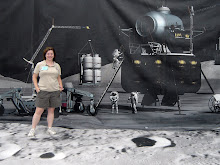
 On Feb. 22, we held an all-female uplink team for the Spirit rover! Yay! The rover science and engineering teams have a substantial number of women on them, and uplink teams have been nearly all female just by chance a good number of times, but when our only current female Mission Manager, Cindy, decided to move on to MSL, Ashley (that's her in the photo, wearing a 9-blue-diamond necklace at the Smithsonian) coordinated a true all-women uplink day. And I got to be the Science team chair! What a fantastic experience. It was so interesting to me that having all women didn't really make a difference at all to planning the day. We're all just good at our jobs and get things done! However, both rovers planned nearly identical sols and Spirit was done well before Opportunity ;) And i love being part of a team that can make history for something that we on the rover team now take for granted - that everyone brings knowledge, enthusiasm, and experience to operating these rovers - regardless of gender.


In 2005, NASA selected a team for the development of a lunar lander spacecraft consistent with the goals set forth in the Administration's Renewed Spirit of Discovery and the National Aeronautics and Space Administration Authorization Act of 2005 (Public Law 109155) which called for a robust lunar robotic program, including robotic lunar landers. The National Research Council's report: The Scientific Context for Exploration of the Moon further supports robotic precursor missions to the Moon's surface and the valuable scientific resource such missions will provide for returning humans to the Moon. The Appropriations Committees agree that the NASA selected mission is of critical importance for the exploration vision. For this purpose, $42,000,000 is provided for this lunar lander mission.
The Program Management Office for NASA’s Lunar Precursor and Robotic Program (LPRP) is based at Marshall Space Flight Center. The program includes the Lunar Reconnaissance Orbiter, LCROSS and Lunar Robotics Lander missions. These missions will gather critical data for the return of the United States to the moon and the potential for a long-term presence there. The bill includes a total of $271.5 million for LPRP, of which $42 million will be for the Lunar Lander mission and another $20 million will be for the program management office for activities associated with the Marshall Space Flight Center. The LPRP management office will be directly involved in the planning and oversight of future lunar robotic missions, integrating lunar data from NASA and other international missions, oversee technology development, and lead NASA’s public outreach and education activities for understanding the lunar environment.
“The LPRP program is an invaluable tool for the scientists and engineers at NASA to determine the best course of action when returning to the moon,” said Shelby. “The President, Congress and the scientific community have repeatedly pointed out the importance of a robotic lunar lander as a precursor to manned flights to the moon. I am glad the bill recognizes this need and Marshall’s role in accomplishing it.”


 Around sol 1257 the winds were howling at their worst. Here's an animation (from Larry Crumpler) of two microscopic images the rock Spirit has been parked over for the storm. It is a bit of silica-rich rock we've been trying to characterize, so it's light-toned and rough. The darker part is the dark basaltic soil and sand in the area. These two images were taken 7 minutes apart. If you look carefully, you can actually see sand grains moving around all over the place. Estimates of the wind velocity are between 60 and 70 miles per hour to get that type of motion on particles that large. (The images are 31 mm across, for scale).